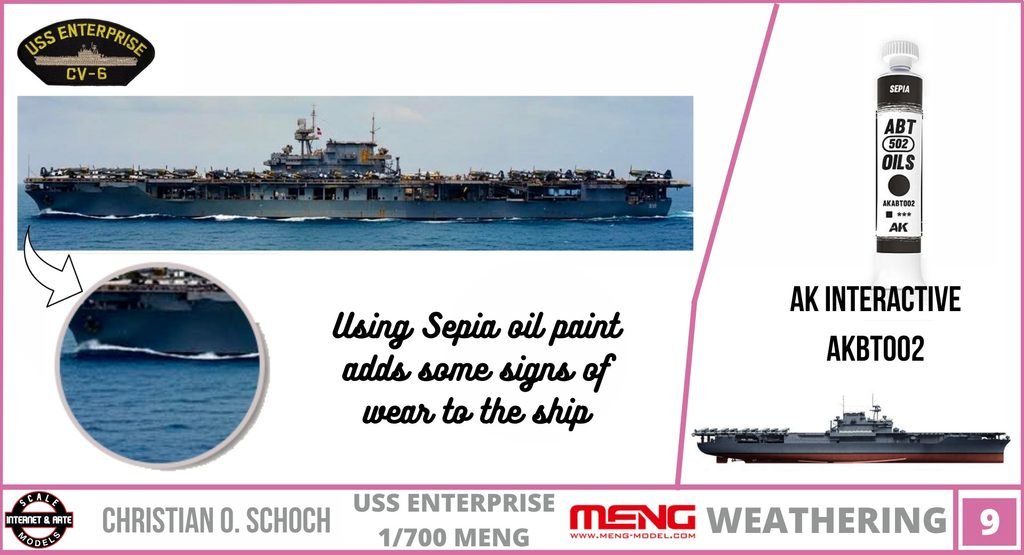
Build Log: USS Enterprise 1945 1/700 Meng – Part 9
Step 9. (Source: Personal archive/Christian O. Schoch)
Introduction: Bringing History to Life Through Weathering
Weathering is one of the most rewarding stages of scale ship modeling. It transforms a carefully assembled and painted miniature into a convincing representation of a vessel that has spent months or years exposed to the elements, operating under demanding conditions at sea. In my Meng Model 1/700 scale USS Enterprise (CV-6), kit PS-005, weathering plays an essential role in recreating the appearance of this legendary American aircraft carrier during the final stages of the Second World War.
In this ninth step of my modeling project, I focus on the application of sepia oil paint to introduce subtle weathering effects across the ship. Unlike a simple wash intended only to emphasize panel lines and structural details, sepia oil paint can help create tonal variations, simulate accumulated grime, and give the model a more natural, lived-in appearance.
For this stage, I recommend AK Interactive AKBT002, an oil paint product suitable for weathering applications. Used carefully, this type of paint allows the modeler to build realistic effects gradually, maintaining control over the intensity and distribution of the weathering.
The objective is not to make the USS Enterprise look neglected or excessively dirty. Rather, it is to reproduce the visual complexity of a working warship exposed to seawater, moisture, exhaust deposits, machinery, aircraft operations, and constant activity.
Why Sepia Is an Effective Color for Naval Weathering
Sepia is a particularly useful color for weathering because it combines brown tones with a darker, slightly muted character. This makes it suitable for creating subtle variations over painted surfaces without introducing the harsh contrast that can result from using pure black.
On a large aircraft carrier such as the USS Enterprise, the flight deck is an especially interesting area to weather. Although the deck was maintained to support intensive flight operations, it was also exposed to considerable wear and contamination. Aircraft movements, maintenance activities, exhaust residues, and the accumulation of dirt all contributed to the complex appearance of an operational carrier.
In 1/700 scale, reproducing these effects requires restraint. A stain that looks convincing on a full-size vessel may become exaggerated when translated directly into a miniature. The purpose of sepia oil paint is therefore to suggest the presence of grime and discoloration rather than reproduce every mark at its original intensity.
The brown tones of sepia can also complement the blue shades used in my model. The Tamiya XF-18 Medium Blue and XF-17 Sea Blue provide the foundation for the carrier’s painted appearance, while the oil paint introduces subtle differences in tone. These variations help prevent the finished surfaces from looking completely uniform.
The result is a more visually engaging model in which the flight deck and other details appear to have depth, texture, and a convincing sense of scale.
Choosing AK Interactive AKBT002
For modelers interested in reproducing this technique, I recommend AK Interactive AKBT002 as the oil paint to consider for the application of sepia weathering effects.
Oil paints are especially useful in scale modeling because their working properties allow the modeler to adjust an application after the initial paint has been placed on the surface. Depending on the product formulation, the amount applied, and the working conditions, the paint may remain workable long enough to soften edges, reduce intensity, or redistribute the pigment.
This flexibility is valuable when working on a 1/700 aircraft carrier. The flight deck contains large areas where uncontrolled staining can quickly become visually distracting. By applying a limited amount of oil paint and adjusting it carefully, it becomes possible to introduce irregularity without sacrificing the overall appearance of the camouflage and deck finish.
Before beginning, I recommend checking the manufacturer’s instructions for the specific product, including its drying characteristics and compatibility with the underlying finish. A fully cured protective varnish provides a useful working surface and helps separate the weathering stage from the previous painting and decal work.
It is also advisable to test the technique on a spare painted surface or an inconspicuous area before proceeding across the main deck. Different varnishes and paint systems can react differently to weathering products and their associated solvents.
The important principle is to work in controlled stages. A subtle effect can always be intensified later, whereas an excessively strong application may require additional work to correct.
Preparing the Flight Deck for Weathering
Before applying sepia oil paint, the surface should be clean, dry, and free from loose dust. Any previous painting, varnishing, and decal work should have been allowed to dry or cure according to the relevant product instructions.
In my USS Enterprise project, the preceding steps established the basic blue finish and prepared the model for further detailing. The application of a gloss varnish before decals and the subsequent weathering process helped establish a defined sequence for the finishing work.
A protective varnish is useful because it can create a more predictable surface for the weathering medium. The degree of gloss affects how the oil paint spreads, settles, and interacts with the surface. On a smoother finish, the paint may move more readily, while a less glossy surface can encourage it to remain in place and create stronger local staining.
Neither result is automatically better. The ideal approach depends on the effect being pursued and the behavior of the materials used.
For a flight deck, I prefer to keep the overall appearance restrained. The aim is to preserve the visual identity of the carrier while introducing enough tonal variation to make the surface look more realistic under close inspection.
Applying Sepia Oil Paint
The application begins with a small amount of sepia oil paint. It is better to use less material than seems necessary and increase the effect gradually.
Using a fine brush, place the paint selectively in areas where darker tonal variations would contribute to the impression of an operational vessel. These may include subtle surface irregularities, selected structural details, and portions of the deck where localized staining can enhance the visual effect.
The paint should not be distributed uniformly across the entire flight deck. Realistic weathering rarely produces a perfectly consistent pattern, and an even brown coating can make the model appear artificially dirty.
Instead, vary the placement and intensity of the paint. Some areas should remain relatively clean, while others can receive slightly more noticeable discoloration. This contrast creates a natural appearance without requiring dramatic streaks or heavy deposits.
Once the oil paint has been applied, allow it to remain workable for an appropriate period. Its behavior depends on the specific product, the amount used, the surface finish, and environmental conditions.
If the effect becomes too strong, use a clean, suitable brush or an appropriate cleaning method recommended by the manufacturer to soften and redistribute the paint. Work gently, avoiding unnecessary pressure that could damage decals or disturb the underlying finish.
The objective is to integrate the sepia into the painted surface rather than leave obvious brush marks or isolated, excessively dark patches.
Controlling the Intensity of the Weathering
One of the greatest advantages of oil paint is the ability to refine an effect after the initial application. This is particularly important when working at 1/700 scale, where even a small amount of pigment can have a considerable visual impact.
After placing the sepia, step back and examine the model from a normal viewing distance. Close inspection can make small details appear more prominent than they will when the ship is displayed on a shelf or photographed as part of a completed scene.
If the weathering looks too uniform, introduce greater variation by selectively reducing some areas while allowing others to remain slightly darker. If the finish appears too dirty, remove or soften part of the application rather than adding more colors immediately.
Patience is essential. Oil paint can change in appearance as it dries, and a wet application may look darker or more pronounced than the final result. For this reason, it is sensible to evaluate the finish under consistent lighting and allow sufficient drying time before deciding whether further weathering is necessary.
The goal is a balanced finish that supports the model’s historical character without overwhelming the underlying paintwork.
Creating a Convincing Operational Appearance
The USS Enterprise was one of the most important aircraft carriers in American naval history. During the Second World War, it participated in extensive combat operations across the Pacific, supporting aircraft missions and operating under the demanding conditions of naval warfare.
Representing such a vessel in miniature involves more than reproducing its shape and camouflage. Weathering helps communicate the working environment in which the ship operated.
The flight deck was a functional surface, not simply a decorative element. It had to accommodate aircraft, personnel, maintenance activities, and the repeated movement of equipment. The surrounding structure was similarly exposed to the effects of the marine environment.
Sepia oil paint can suggest some of this complexity through restrained tonal variation. However, it is important to remember that weathering is an interpretation rather than a precise record of the ship’s condition on a particular day in 1945. Photographic references and historical documentation remain valuable guides when a modeler wishes to reproduce a specific operational appearance.
For my project, the priority is to achieve a convincing representation of the USS Enterprise in 1945 while maintaining a coherent overall finish.
Common Mistakes to Avoid
There are several mistakes worth avoiding when using sepia oil paint on a small-scale warship.
Applying too much paint: Heavy brown staining can overpower the blue finish and make the flight deck look unrealistic. Begin with a small quantity and build the effect gradually.
Creating uniform discoloration: An evenly distributed layer of sepia can make the deck appear artificially coated. Selective application produces more convincing variation.
Working over an inadequately cured finish: The solvents associated with weathering products may affect some underlying paints, varnishes, or decals. Follow the manufacturers’ recommendations and test compatibility before proceeding.
Ignoring the scale: In 1/700 scale, subtle effects often look more realistic than exaggerated streaks and stains. Always consider how the model will appear at normal viewing distance.
Rushing the drying process: Oil paints can take considerable time to dry. Allow sufficient time before handling the model or applying additional finishing products.
Avoiding these mistakes makes the process more predictable and helps preserve the quality of the work completed in previous stages.
Conclusion: Subtle Weathering Makes the Difference
Applying sepia oil paint is an important step in giving my Meng Model 1/700 USS Enterprise (CV-6) a more convincing operational appearance. The technique introduces tonal variation, suggests accumulated grime, and adds visual depth to the flight deck without requiring an excessively complicated process.
For this stage, I recommend AK Interactive AKBT002 as a suitable oil paint to consider for creating sepia weathering effects. The key to success lies not only in the material itself but also in the way it is applied, adjusted, and integrated with the underlying finish.
A restrained approach is especially important in 1/700 scale. Small variations in color can have a substantial impact, and the most convincing results often come from gradual adjustments rather than dramatic effects.
As the USS Enterprise project progresses, each finishing stage contributes to the overall impression of a historical vessel. By combining careful painting, protective varnishing, decals, and controlled weathering, it becomes possible to create a model that is visually engaging while respecting the character of this famous aircraft carrier.
For me, the purpose of weathering is not simply to make a model look old or dirty. It is to suggest the passage of time, the demands of naval operations, and the complex environment in which the ship served. When used with care, sepia oil paint provides another valuable tool for bringing that history to life in miniature.
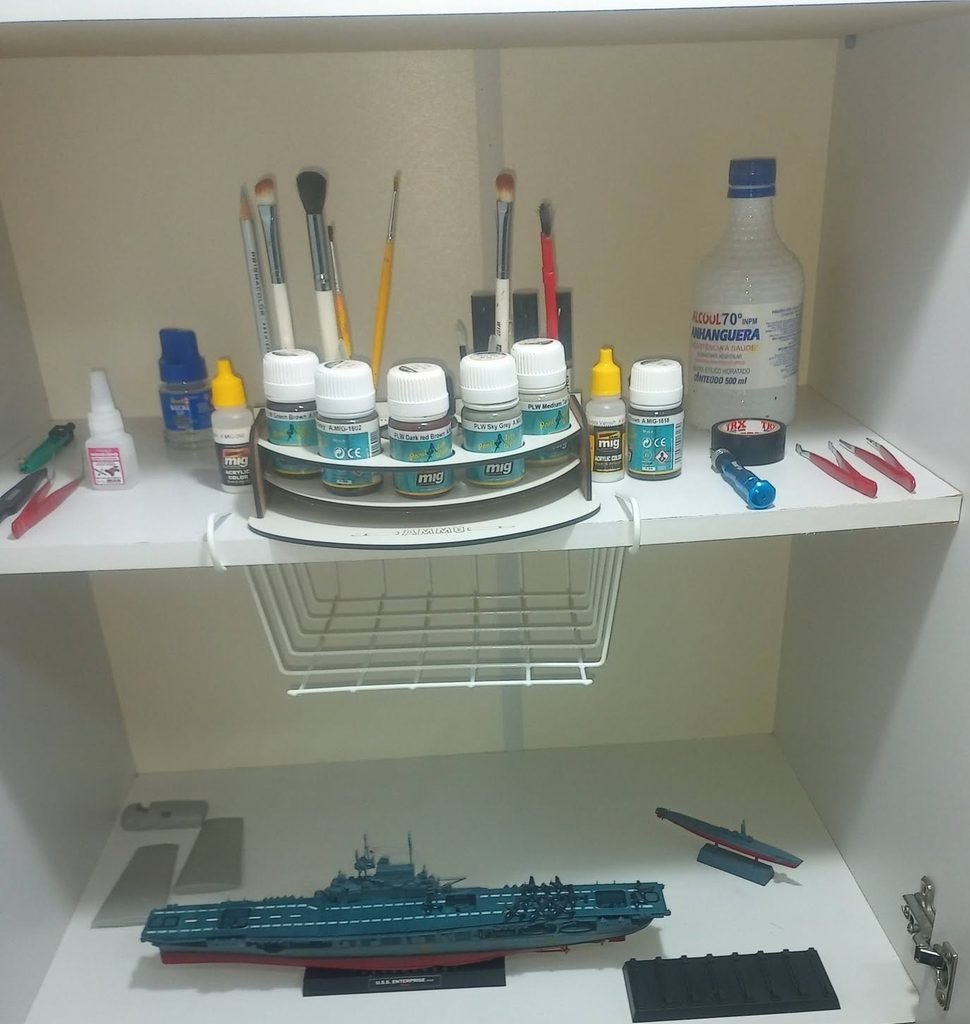
The modeling workbench (Source: Personal archive/Christian O. Schoch)
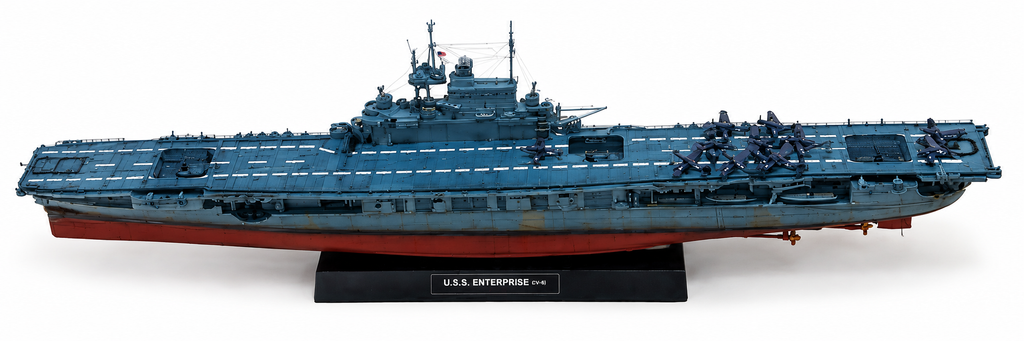
Finished scale model. (Source: Personal archive/Christian O. Schoch)
READ MORE:
- Build Log: USS Enterprise 1945 1/700 Meng – Part 1
- Build Log: USS Enterprise 1945 1/700 Meng – Part 2
- Build Log: USS Enterprise 1945 1/700 Meng – Part 3
- Build Log: USS Enterprise 1945 1/700 Meng – Part 4
- Build Log: USS Enterprise 1945 1/700 Meng – Part 5
- Build Log: USS Enterprise 1945 1/700 Meng – Part 6
- Build Log: USS Enterprise 1945 1/700 Meng – Part 7
- Build Log: USS Enterprise 1945 1/700 Meng – Part 8
- Build Log: USS Enterprise 1945 1/700 Meng – Part 9
- Build Log: USS Enterprise 1945 1/700 Meng – Part 10
- Build Log: USS Enterprise 1945 1/700 Meng – Part 11
- Build Log: USS Enterprise 1945 1/700 Meng – Part 12
- Build Log: USS Enterprise 1945 1/700 Meng – Part 13
- Build Log: USS Enterprise 1945 1/700 Meng – Part 14
- Build Log: USS Enterprise 1945 1/700 Meng – Part 15
Thank you to all of my patrons on Patreon for your monthly support of my work. I truly appreciate it.
Patrons receive a printed copy of my book Zero Fighter Historical Society, delivered straight to your home at no additional cost.
*(Please note: this offer is not available in all countries)
Become a patron at www.patreon.com/ZeroSociety
