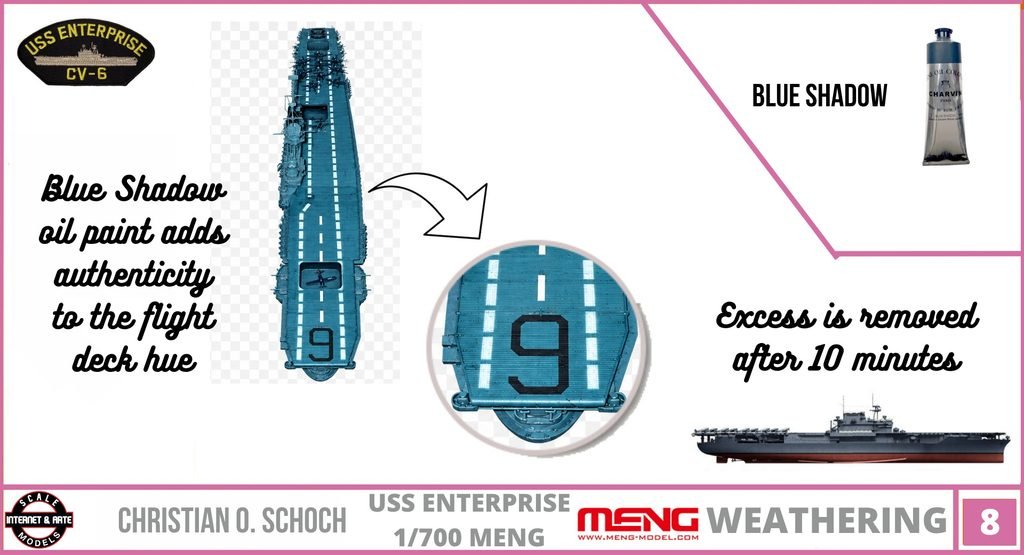
Build Log: USS Enterprise 1945 1/700 Meng – Part 8
Step 8. (Source: Personal archive/Christian O. Schoch)
Bringing the Flight Deck to Life
Weathering is one of the most rewarding stages of scale modeling because it transforms a carefully assembled and painted model into a miniature representation of a real object exposed to time, weather, and operational use. On a World War II aircraft carrier such as the USS Enterprise (CV-6), the flight deck offers an excellent opportunity to explore these effects. Its broad surface, exposed position, and constant activity make it an essential visual feature of the finished model.
In this eighth stage of my Meng Model 1/700 scale USS Enterprise project, I introduce oil paint to the flight deck to create a more convincing and visually interesting finish. The color selected for this step is Blue Shadow, an oil paint that can help produce subtle tonal variations, reinforce surface details, and give the deck a more natural appearance.
The objective is not to make the flight deck look dramatically weathered or excessively dirty. Instead, I want to create a convincing impression of a working aircraft carrier in 1945, when the Enterprise had already experienced years of demanding wartime operations.
The technique is straightforward: apply the oil paint carefully, allow it to work on the surface for approximately ten minutes, and then remove the excess. Although this process requires patience and a light touch, it can make a significant difference to the final appearance of a model at this scale.
Why Weathering Matters on a 1/700 Scale Model
Working in 1/700 scale presents a particular challenge. Every detail must be carefully balanced because even small amounts of paint can become visually exaggerated when viewed at close range.
A flight deck painted in a single uniform shade can look clean and technically correct, but it may also appear flat and artificial. Real surfaces rarely maintain exactly the same appearance across their entire area. Lighting, moisture, dirt, maintenance, mechanical activity, and repeated exposure to the elements all contribute to subtle variations in color and texture.
Aircraft carrier flight decks were especially demanding working environments. Aircraft were moved, parked, serviced, and prepared for operations across the available deck space. Crew members worked continuously, while aircraft engines, exhaust deposits, fuel, lubricants, and ordinary operational wear contributed to the changing appearance of the surfaces.
These conditions provide useful historical context for weathering a model of the Enterprise. However, the goal is not to reproduce every possible stain or mark. Rather, it is to suggest the cumulative effects of service through carefully controlled paintwork.
Oil paints are particularly useful for this purpose because their working properties allow the modeler to manipulate the finish gradually. Their relatively long working time makes it possible to adjust the intensity of an effect before it becomes permanent.
Blue Shadow is the color I selected for this stage because it can introduce a cool, understated tonal variation that complements the blue tones already present on the flight deck.
Choosing Blue Shadow Oil Paint
The choice of weathering color is important because the final result depends not only on the paint itself but also on the underlying colors, the surface preparation, and the amount of pigment left behind.
Blue Shadow offers an interesting alternative to conventional dark brown or black weathering. Those colors can be useful for specific stains and accumulated grime, but they may create an overly warm or dirty appearance if applied indiscriminately across a large surface.
A blue-toned oil paint can provide a different visual effect. Depending on the underlying paint and the lighting, it can introduce cooler shadows and subtle variations that make the deck appear less uniform without immediately suggesting heavy dirt.
The key is restraint. At 1/700 scale, a thin film of oil paint can have a greater visual impact than expected. A strong application may obscure the original color or make the flight deck appear much darker than intended.
For this reason, I approach Blue Shadow as a weathering medium rather than as a new base coat. The original Tamiya paintwork must remain visible, and the oil paint should complement the finish rather than replace it.
It is also important to remember that historical accuracy does not depend on one particular weathering color. The appearance of a wartime flight deck varied according to its materials, maintenance, operational conditions, and exposure. Blue Shadow is a modeling choice intended to enhance the visual result, not a claim that the original deck possessed a distinct blue oil stain.
Preparing the Surface for Oil Weathering
Before applying oil paint, I make sure the underlying finish is sufficiently dry and stable. In the previous stage of this project, I applied a gloss varnish in preparation for the decals and the subsequent weathering process.
A fully cured, compatible varnish layer can help protect the paint beneath it and provide a more predictable surface for further work. Nevertheless, oil paints, solvents, and varnishes are not universally compatible, so it is advisable to test the products together on a spare surface or an inconspicuous area.
Preparation also involves examining the flight deck under good lighting. I look for uneven paint coverage, visible dust, and any imperfections that might interfere with the weathering process.
At this stage, the objective is to preserve the work already completed. There is little benefit in creating an attractive weathering effect if the original paintwork is damaged in the process.
A clean brush, a suitable applicator, and a soft, lint-free material for removing excess paint are useful tools. I also work with small quantities of oil paint, making adjustments gradually rather than applying too much pigment at once.
The better the preparation, the easier it becomes to control the final effect.
Applying Blue Shadow to the Flight Deck
With the surface ready, I begin applying the Blue Shadow oil paint to the flight deck.
The important principle is to maintain control over the amount of paint being used. Instead of treating the entire deck as a surface that must receive an identical layer, I focus on achieving a subtle overall effect that can later be refined.
Oil paint should not overwhelm the underlying finish. The aim is to introduce depth and tonal variation while preserving the original deck color, the painted details, and the overall visual balance of the model.
At this scale, a thin and carefully distributed application is generally more effective than a heavy coat. Too much paint can create an artificial appearance, obscure fine details, and make the surface look muddy rather than realistically weathered.
Blue Shadow works as part of a broader finishing process. Its contribution becomes more convincing when it interacts with the underlying paint instead of completely covering it.
I also keep the visual character of the Enterprise in mind. This is a model of a historic aircraft carrier during the final year of the Second World War, not a derelict ship abandoned for decades. The weathering should suggest operational use, regular activity, and exposure to the elements while respecting the vessel’s maintained condition.
This distinction is essential to achieving a believable result.
The Ten-Minute Waiting Period
One of the defining details of this technique is the waiting period.
After applying the Blue Shadow oil paint, I allow it to remain on the surface for approximately ten minutes before removing the excess. This interval gives me time to work with the paint while it is still manageable.
The waiting period is not a universal rule for every oil paint or every modeling situation. Temperature, ventilation, the thickness of the application, the type of oil paint, and the underlying surface can all influence how the paint behaves.
For my process, however, ten minutes provides a useful starting point. It allows the paint to settle before I begin refining the effect.
During this time, I avoid rushing into the removal stage. Weathering is often most successful when the modeler observes the surface carefully and makes deliberate decisions instead of working too quickly.
The purpose of waiting is not necessarily to let the oil paint dry completely. Rather, it gives the application time to develop enough for the next step while retaining the workability needed to remove unwanted material.
If the paint begins to behave differently than expected, I adjust the timing accordingly. Testing the technique on a spare painted surface is particularly helpful when using unfamiliar products.
Removing the Excess: Controlling the Final Appearance
After approximately ten minutes, I remove the excess oil paint.
This is the stage where the character of the weathering becomes apparent. The initial application establishes the effect, but the removal process determines how much of that effect remains visible.
I work gently, using a suitable soft material and avoiding unnecessary pressure. The objective is to reduce the amount of paint on the surface while retaining a subtle tonal variation.
It is important not to remove the paint indiscriminately. If too much is wiped away, the weathering effect may become almost invisible. If too much remains, the deck can look excessively dark or stained.
Finding the right balance requires observation and patience.
I prefer a result that looks restrained when viewed from normal viewing distance but reveals additional depth when examined more closely. This approach is especially appropriate for a 1/700 scale aircraft carrier, where excessive weathering can quickly overpower the model’s fine details.
If necessary, I can refine the finish gradually rather than attempting to achieve the entire effect in one pass. Small adjustments are easier to control and generally provide a more natural result.
Any cleaning material or solvent used during this stage should be compatible with the underlying paint and varnish. Strong rubbing or an unsuitable solvent can damage the finish, so caution is essential.
Once the excess has been removed, the flight deck begins to acquire a more nuanced appearance. The underlying color remains the foundation, while the oil paint contributes subtle shadows and visual depth.
Creating a Convincing 1945 Appearance
The ultimate purpose of this technique is to support the historical character of the USS Enterprise.
By 1945, the Enterprise had participated in numerous major operations across the Pacific. Its long service history provides a compelling reason to portray the ship as an operational warship rather than as a pristine display piece.
Nevertheless, historical realism is not the same as applying as much dirt and discoloration as possible. A convincing model depends on the relationship between the ship’s documented service, the characteristics of its surfaces, and the restraint used during painting and weathering.
The flight deck should remain recognizable as a functional working surface. Its visual interest comes from the subtle interaction of colors, the preservation of details, and the impression that the ship has been used without being neglected.
Blue Shadow contributes to that impression by breaking up the uniformity of the painted surface. The effect is deliberately understated, allowing the original colors and the overall shape of the deck to remain prominent.
This is particularly important in a small-scale model, where the viewer must be able to appreciate the entire vessel without being distracted by oversized weathering effects.
Final Thoughts: Small Details, Significant Results
Applying Blue Shadow oil paint is a relatively simple step, but it illustrates an important principle of scale modeling: convincing realism often comes from controlled adjustments rather than dramatic transformations.
For this stage of my Meng Model 1/700 USS Enterprise project, I apply the oil paint to the flight deck, allow approximately ten minutes for the effect to develop, and then remove the excess carefully.
The process introduces subtle tonal variation, adds depth to the surface, and helps the deck look less uniform. Most importantly, it allows the original paintwork to remain visible while giving the model a more convincing operational character.
The technique does not require an elaborate collection of specialized tools. What matters most is understanding the behavior of the paint, using a restrained application, protecting the underlying finish, and knowing when to stop.
For modelers interested in improving the appearance of a World War II aircraft carrier, Blue Shadow oil paint is worth considering as part of a carefully planned weathering process. Its value lies not in creating an obvious blue coating, but in helping the surface look more complex and visually natural.
As the project progresses, these subtle finishing decisions will work together with the earlier painting stages and the details still to come. The result I am pursuing is a miniature representation of the USS Enterprise in 1945 that respects the ship’s historical significance while demonstrating how thoughtful painting and weathering can bring a scale model to life.
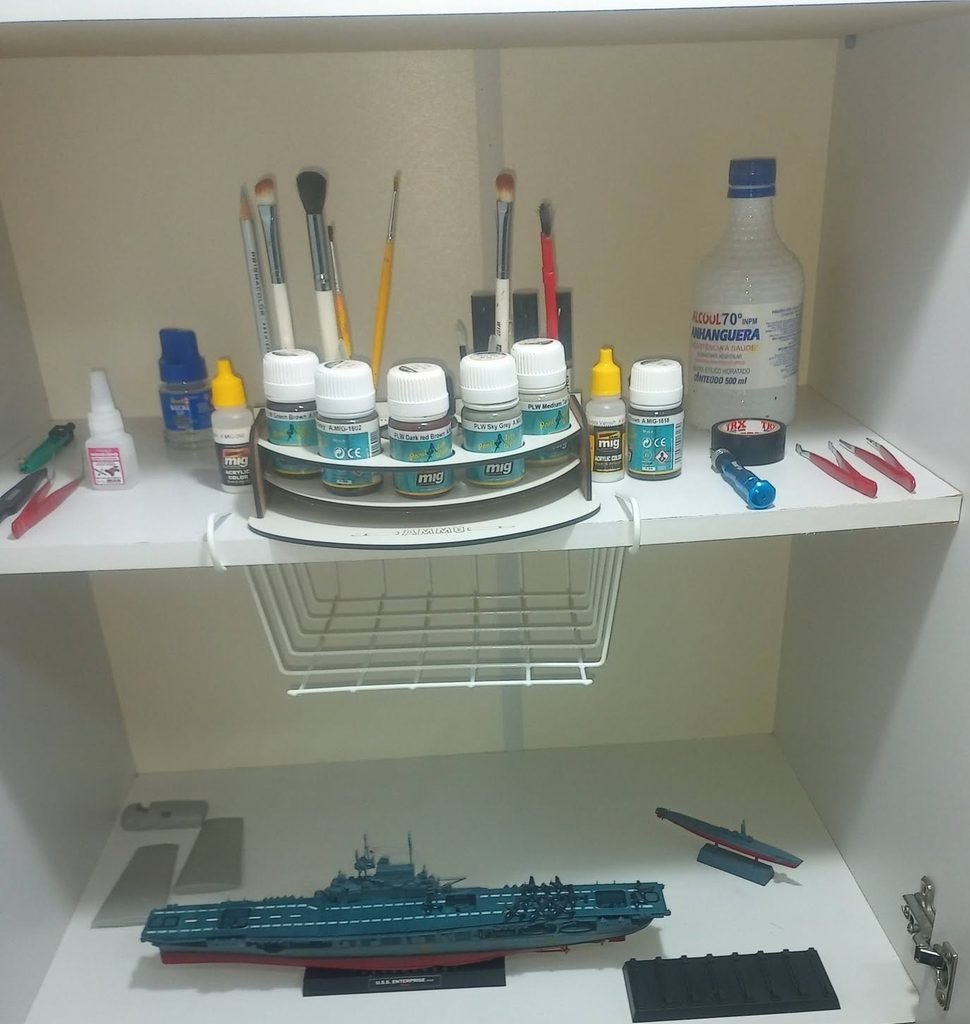
The modeling workbench (Source: Personal archive/Christian O. Schoch)
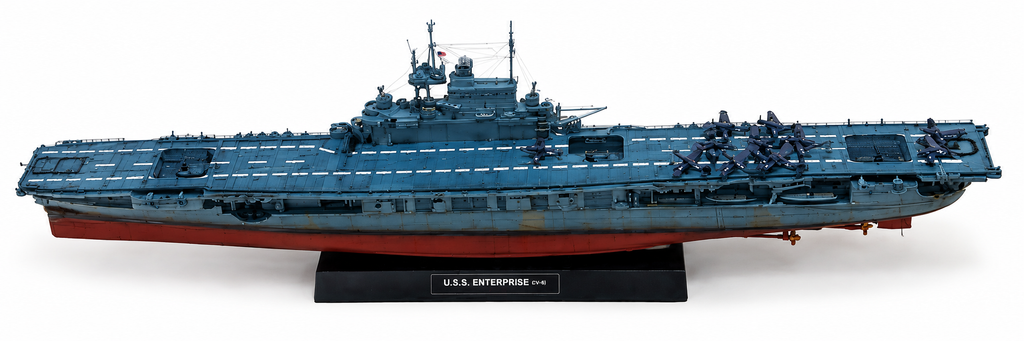
Finished scale model. (Source: Personal archive/Christian O. Schoch)
READ MORE:
- Build Log: USS Enterprise 1945 1/700 Meng – Part 1
- Build Log: USS Enterprise 1945 1/700 Meng – Part 2
- Build Log: USS Enterprise 1945 1/700 Meng – Part 3
- Build Log: USS Enterprise 1945 1/700 Meng – Part 4
- Build Log: USS Enterprise 1945 1/700 Meng – Part 5
- Build Log: USS Enterprise 1945 1/700 Meng – Part 6
- Build Log: USS Enterprise 1945 1/700 Meng – Part 7
- Build Log: USS Enterprise 1945 1/700 Meng – Part 8
- Build Log: USS Enterprise 1945 1/700 Meng – Part 9
- Build Log: USS Enterprise 1945 1/700 Meng – Part 10
- Build Log: USS Enterprise 1945 1/700 Meng – Part 11
- Build Log: USS Enterprise 1945 1/700 Meng – Part 12
- Build Log: USS Enterprise 1945 1/700 Meng – Part 13
- Build Log: USS Enterprise 1945 1/700 Meng – Part 14
- Build Log: USS Enterprise 1945 1/700 Meng – Part 15
Thank you to all of my patrons on Patreon for your monthly support of my work. I truly appreciate it.
Patrons receive a printed copy of my book Zero Fighter Historical Society, delivered straight to your home at no additional cost.
*(Please note: this offer is not available in all countries)
Become a patron at www.patreon.com/ZeroSociety
