Build Log: USS Enterprise 1945 1/700 Meng – Part 13
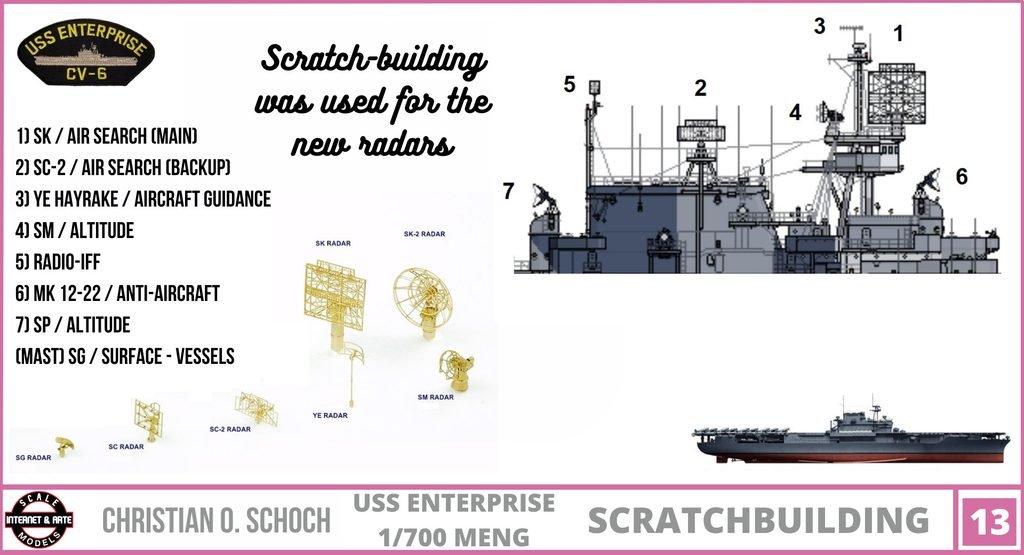
Step 13. (Source: Personal archive/Christian O. Schoch)
Introduction: A New Dimension of Naval Warfare
The USS Enterprise (CV-6), famously known as The Big E, was one of the most distinguished American aircraft carriers of the Second World War. Throughout the Pacific campaign, she underwent numerous modifications as the United States Navy adapted its ships to the rapidly changing demands of naval warfare. Among the most important developments was the growing sophistication of radar technology and its integration into carrier operations.
For this stage of my 1/700 scale model project, I used scratchbuilding techniques to reproduce the additional radar antennas associated with the Enterprise’s late-war configuration. These small structures might appear insignificant when compared with the ship’s massive flight deck, island, and gun batteries, but they represent an essential part of her technological evolution.
My objective was to capture the appearance of a carrier that had become much more than a platform for launching aircraft. By 1945, the Enterprise had developed into a sophisticated command center capable of coordinating increasingly complex air operations, including missions conducted at night.
Reproducing these radar installations required careful observation, an understanding of their historical purpose, and a willingness to create miniature components that could not simply be represented by the original kit parts.
The USS Enterprise and the Evolution of Radar
When the Enterprise entered service in 1938, shipborne radar was still an emerging technology. Its potential for detecting approaching aircraft and ships was considerable, but the equipment was bulky, technically demanding, and continuously evolving.
The carrier received early radar equipment before the United States entered the war. Subsequent upgrades improved her ability to detect threats, track contacts, and coordinate defensive responses. As the Pacific War progressed, radar became increasingly important to fleet operations, especially as Japanese aircraft began conducting attacks under conditions that made visual detection difficult.
By the later stages of the war, the Enterprise had a more sophisticated collection of radar and communications equipment. Different systems performed different functions, and their antennas were distributed around the ship’s island, masts, and other elevated positions.
This distinction matters when building a historically convincing model. A carrier’s radar installation was not simply a collection of similar aerials placed wherever space was available. Each antenna belonged to a system designed for a particular operational purpose.
The ship’s equipment also changed over time, meaning that a model intended to represent the Enterprise in 1945 should not automatically reproduce the configuration seen in photographs from 1942 or 1943.
The U.S. Navy’s photographic archives provide valuable references for studying these changes. A particularly useful example is the photograph of the Enterprise taken at Puget Sound Navy Yard on October 19, 1943, which documents radar installations during an important period of modernization.
Reference: Naval History and Heritage Command — USS Enterprise, October 19, 1943.
Understanding the Main Radar Systems
Before reproducing the antennas, it is worth understanding the technology behind them. Although the equipment was designed decades before modern digital systems, its operating principles laid important foundations for modern naval surveillance.
SK Air-Search Radar
The SK radar was an important long-range air-search system used by the U.S. Navy during the later war years. Its principal task was to detect aircraft approaching the fleet and provide early warning to the ship’s combat organization.
Unlike a lookout relying on visibility, radar operators could identify potential contacts at considerable distances, including when darkness or poor weather reduced the effectiveness of visual observation.
The antenna’s elevated position was important because radar detection depended partly on the geometry between the transmitting antenna and the target. Although radar could not eliminate the effects of the Earth’s curvature, height helped extend the area that could be observed.
On the Enterprise, the main air-search antenna was associated with the large forward mast. Its distinctive framework is an important visual feature for anyone attempting to reproduce the carrier’s later appearance.
SG Surface-Search Radar
The SG radar was designed primarily to detect surface targets. It could help the ship identify vessels and other contacts in the surrounding waters, particularly when visibility was poor.
This capability was useful during nighttime navigation, formation operations, and encounters with enemy vessels. Surface-search radar complemented air-search equipment rather than replacing it.
For scale modelers, the SG installation is interesting because its antenna differs in appearance from the large air-search structures. These differences help give the carrier’s island a convincing technical character.
SM Radar and Fire-Control Equipment
The Enterprise also employed radar equipment associated with directing naval gunfire and improving the accuracy of defensive engagements.
The SM radar contributed to the ship’s radar-directed fire-control capability. Its role should be distinguished from that of the SK air-search radar: one supported the detection of approaching threats over a broad area, while fire-control equipment helped provide information needed to engage targets.
The carrier’s Mark 37 gun directors, equipped with fire-control radar, were another important part of this defensive system. These directors helped coordinate the ship’s anti-aircraft artillery.
Together, the different radar systems formed part of a broader network of detection, tracking, communication, and engagement capabilities.
The precise arrangement of antennas changed during the Enterprise’s service. Consequently, the best reference for a specific modeling project is a photograph or reliable reconstruction matching the intended date, rather than a generic illustration of a wartime American carrier.
From Radar Detection to Night Carrier Operations
The Enterprise’s relationship with nighttime warfare went beyond the installation of shipboard radar.
During the war, the Navy increasingly recognized that radar-equipped aircraft could operate as valuable partners in nighttime defense. Aircraft radar allowed crews to detect contacts that might otherwise have remained invisible in darkness, while specialized night fighters could use airborne radar to intercept enemy aircraft.
This development was especially important because a ship’s radar and an aircraft’s radar performed different but complementary tasks. Shipboard systems helped the carrier and its combat organization understand the surrounding tactical situation. Airborne equipment allowed individual aircraft to search for and intercept targets while operating away from the ship.
The Enterprise played a significant role in this evolution. In November 1943, Commander Edward H. “Butch” O’Hare and the carrier’s air officer, Tom Hamilton, experimented with tactics using radar-equipped aircraft to direct fighters against nighttime threats.
By December 1944, the carrier had embarked Night Air Group Ninety (NAG-90), and she operated in the specialized night-carrier role, designated CV(N)-6.
The group’s aircraft included TBM Avengers equipped with APS-3 radar and F6F-5(N) Hellcats equipped with APS-6 or APS-6A radar systems. These airborne installations were different from the antennas fitted to the carrier itself.
During the following months, NAG-90 conducted extensive nighttime operations against Japanese targets. These missions included attacks on shipping and shore installations, as well as operations associated with the campaigns for Iwo Jima and Okinawa.
This history gives the radar components on my model a significance beyond their physical dimensions. They represent a period when radar technology, specialized aircraft, and new operational methods were becoming increasingly integrated into naval warfare.
Historical reference: USS Enterprise CV-6 — Night Air Operations.
Scratchbuilding: Creating the Missing Details
For my model, the main challenge was translating these historical installations into components small enough to fit convincingly on a 1/700 scale aircraft carrier.
At this scale, the available space is extremely limited. A component measuring just a few millimeters can become a prominent feature once it is positioned against the island or the ship’s mast. Conversely, a radar antenna that is too thick or incorrectly shaped can look disproportionately heavy.
Scratchbuilding offers a practical solution when the kit does not provide the required detail or when its supplied parts do not adequately represent the intended configuration.
Rather than accepting the limitations of the original components, I created the additional radar structures myself, concentrating on their overall silhouettes, relative dimensions, and placement.
The first step was to study photographic references and identify the characteristic shape of each installation. I then considered how to simplify these structures without losing the features that distinguish one radar antenna from another.
At 1/700 scale, reproducing every wire, support, or mechanical detail is neither practical nor necessarily desirable. The goal is to retain the most recognizable structural characteristics while maintaining the delicate appearance of the original equipment.
The process requires patience because the parts must be small enough to look convincing but strong enough to survive handling, painting, and final installation.
Scratchbuilding also introduces a useful degree of flexibility. When a kit does not provide a particular antenna, or when a historical modification needs to be represented, the modeler can adapt the construction to suit the reference material.
Working at 1/700 Scale: Proportion, Placement, and Visual Balance
One of the most important considerations in miniature radar construction is proportion.
Full-size naval radar antennas could have relatively large frameworks, but their model counterparts must be reduced carefully. Simply making every structural member as thick as possible to improve strength can destroy the delicate appearance that makes these installations recognizable.
Placement is equally important. The Enterprise’s island contained multiple antennas, platforms, directors, and communications fittings. Their arrangement created a distinctive silhouette against the sky.
The challenge is to reproduce this complexity without making the model look cluttered. Each component should occupy its intended position and remain visually consistent with the surrounding structures.
Reference photographs are indispensable here. They allow the modeler to compare the shape and location of individual installations while avoiding the temptation to add equipment merely because it appears in photographs of another carrier.
The Enterprise underwent several modifications throughout her career, so historical accuracy depends on choosing the correct period. A configuration from 1943 may not represent the ship as she appeared during her dedicated night-carrier operations in 1945.
For that reason, I regard scratchbuilding as both a construction technique and a research exercise. Every additional component should contribute to a coherent representation of the ship at a specific moment in her history.
Bringing the Late-War Enterprise to Life
The radar installations add another layer of detail to my Meng Model USS Enterprise project. Alongside the flight deck, aircraft, elevators, island, and defensive armament, these small structures help communicate the carrier’s technological sophistication.
They also illustrate why detailed ship modeling is about more than assembling the parts supplied in a box. Some of the most rewarding improvements come from identifying a historically significant feature, researching its purpose, and reproducing it with simple modeling materials and careful workmanship.
The process does not require every component to be manufactured commercially. On the contrary, scratchbuilding encourages the modeler to observe shapes, understand construction, and develop practical solutions to problems that arise during a project.
In this case, the additional radar antennas are especially meaningful because they connect the physical model with the Enterprise’s pioneering role in carrier-based night operations.
Conclusion: Small Antennas, Major Historical Significance
The USS Enterprise was not simply one of the most successful aircraft carriers of the Second World War. She was also part of the technological transition that transformed carrier aviation into a more capable, coordinated, and adaptable fighting system.
Her radar equipment helped improve situational awareness, support defensive coordination, and contribute to the broader development of nighttime naval operations. Combined with radar-equipped aircraft and specialized night-fighter units, these advances expanded what a carrier air group could accomplish after dark.
By using scratchbuilding techniques to reproduce the additional radar installations on my 1/700 model, I sought to capture an important aspect of the Enterprise’s late-war identity.
The finished components may be tiny, but their historical meaning is substantial. They represent the ingenuity of the engineers, technicians, aircrews, and sailors who helped the U.S. Navy adapt to the challenges of modern warfare.
For me, that is one of the greatest rewards of scale modeling: turning a collection of miniature parts into a representation of a real ship, its technology, and the history behind it.
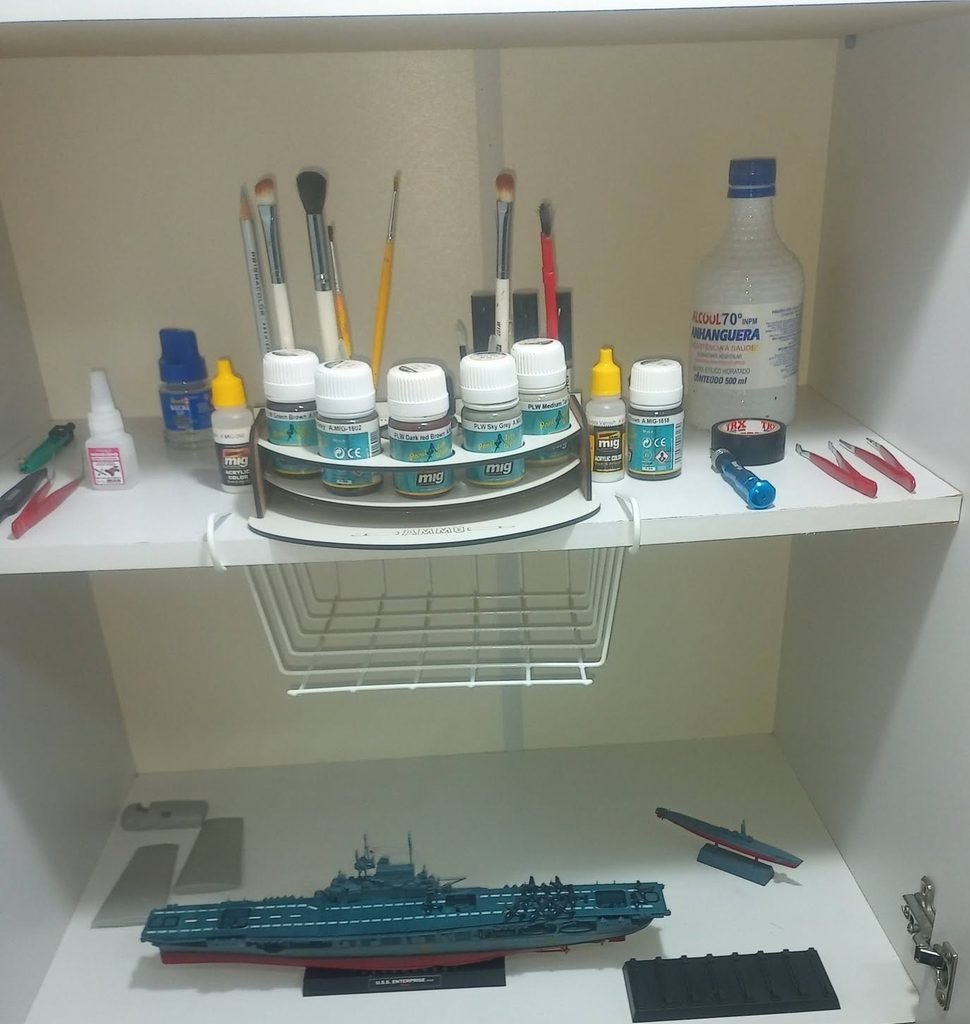
The modeling workbench (Source: Personal archive/Christian O. Schoch)
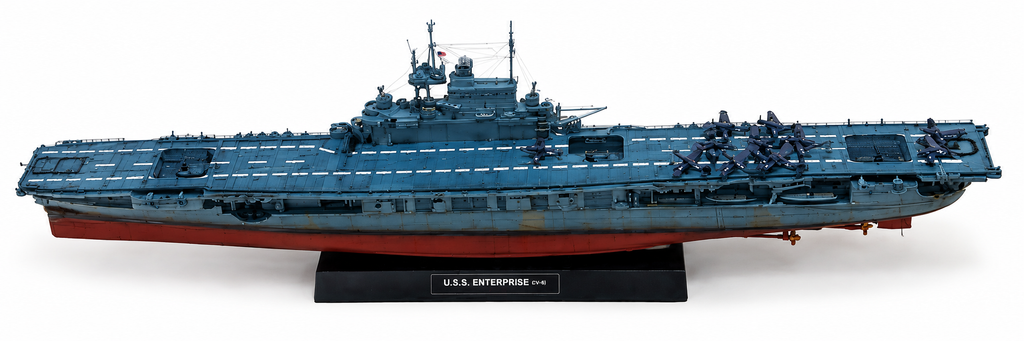
Finished scale model. (Source: Personal archive/Christian O. Schoch)
READ MORE:
- Build Log: USS Enterprise 1945 1/700 Meng – Part 1
- Build Log: USS Enterprise 1945 1/700 Meng – Part 2
- Build Log: USS Enterprise 1945 1/700 Meng – Part 3
- Build Log: USS Enterprise 1945 1/700 Meng – Part 4
- Build Log: USS Enterprise 1945 1/700 Meng – Part 5
- Build Log: USS Enterprise 1945 1/700 Meng – Part 6
- Build Log: USS Enterprise 1945 1/700 Meng – Part 7
- Build Log: USS Enterprise 1945 1/700 Meng – Part 8
- Build Log: USS Enterprise 1945 1/700 Meng – Part 9
- Build Log: USS Enterprise 1945 1/700 Meng – Part 10
- Build Log: USS Enterprise 1945 1/700 Meng – Part 11
- Build Log: USS Enterprise 1945 1/700 Meng – Part 12
- Build Log: USS Enterprise 1945 1/700 Meng – Part 13
- Build Log: USS Enterprise 1945 1/700 Meng – Part 14
- Build Log: USS Enterprise 1945 1/700 Meng – Part 15
Thank you to all of my patrons on Patreon for your monthly support of my work. I truly appreciate it.
Patrons receive a printed copy of my book Zero Fighter Historical Society, delivered straight to your home at no additional cost.
*(Please note: this offer is not available in all countries)
Become a patron at www.patreon.com/ZeroSociety

