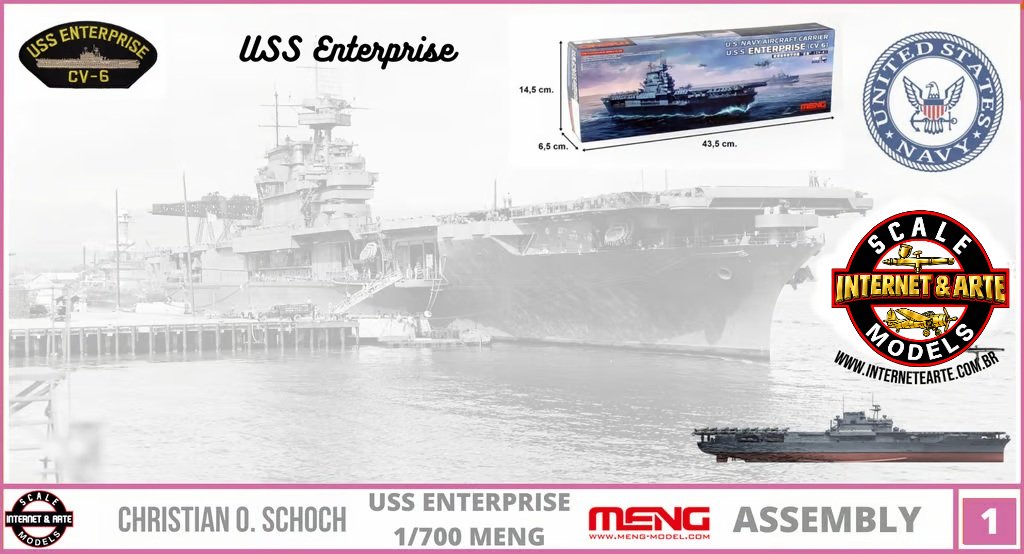
Build Log: USS Enterprise 1945 1/700 Meng
Step 1. (Source: Personal archive/Christian O. Schoch)
The Meng Model 1/700 scale USS Enterprise (CV-6), kit PS-005, offers scale modelers the opportunity to recreate one of the most celebrated aircraft carriers in American naval history. As a member of the Yorktown-class, the Enterprise became an enduring symbol of U.S. Navy operations in the Pacific during the Second World War. Its extensive combat service and association with some of the conflict’s most important naval campaigns have secured its place among the most recognizable warships of the twentieth century.
For enthusiasts of naval history and World War II ship modeling, this kit combines the appeal of a historically significant subject with the practical advantages of the popular 1/700 scale. Its compact dimensions, selection of aircraft, alternative hull configurations, and additional deck components provide several possibilities for creating an engaging display model.
Whether displayed as a complete ship or in a waterline configuration, the Meng PS-005 presents an interesting project for modelers who appreciate the engineering, appearance, and operational history of American aircraft carriers.
Kit Overview and Specifications
The Meng PS-005 is a static plastic scale model kit designed to reproduce the USS Enterprise in miniature. At approximately 36.2 cm (14.25 inches) long and 5.3 cm (2.1 inches) wide, the completed model offers a substantial representation of the carrier without requiring the display space associated with larger scales.
The 1/700 scale is particularly attractive to collectors interested in building multiple warships. It allows a carrier such as the Enterprise to be displayed alongside other vessels, creating opportunities for small naval formations, historical presentations, and Pacific War dioramas.
Kit specifications
- Manufacturer: Meng Model
- Kit number: PS-005
- Subject: USS Enterprise (CV-6)
- Scale: 1/700
- Material: Plastic
- Model type: Static ship model
- Approximate length: 36.2 cm (14.25 inches)
- Approximate width: 5.3 cm (2.1 inches)
- Hull configurations: Full-hull and waterline options
- Aircraft included: SBD Dauntless, TBD Devastator, and F4F Wildcat
- Additional features: Hangar-deck components and aircraft elevator options
- Display accessories: Display base
These features make the kit an appealing choice for modelers seeking a balance between manageable dimensions and the visual presence of a major World War II warship.
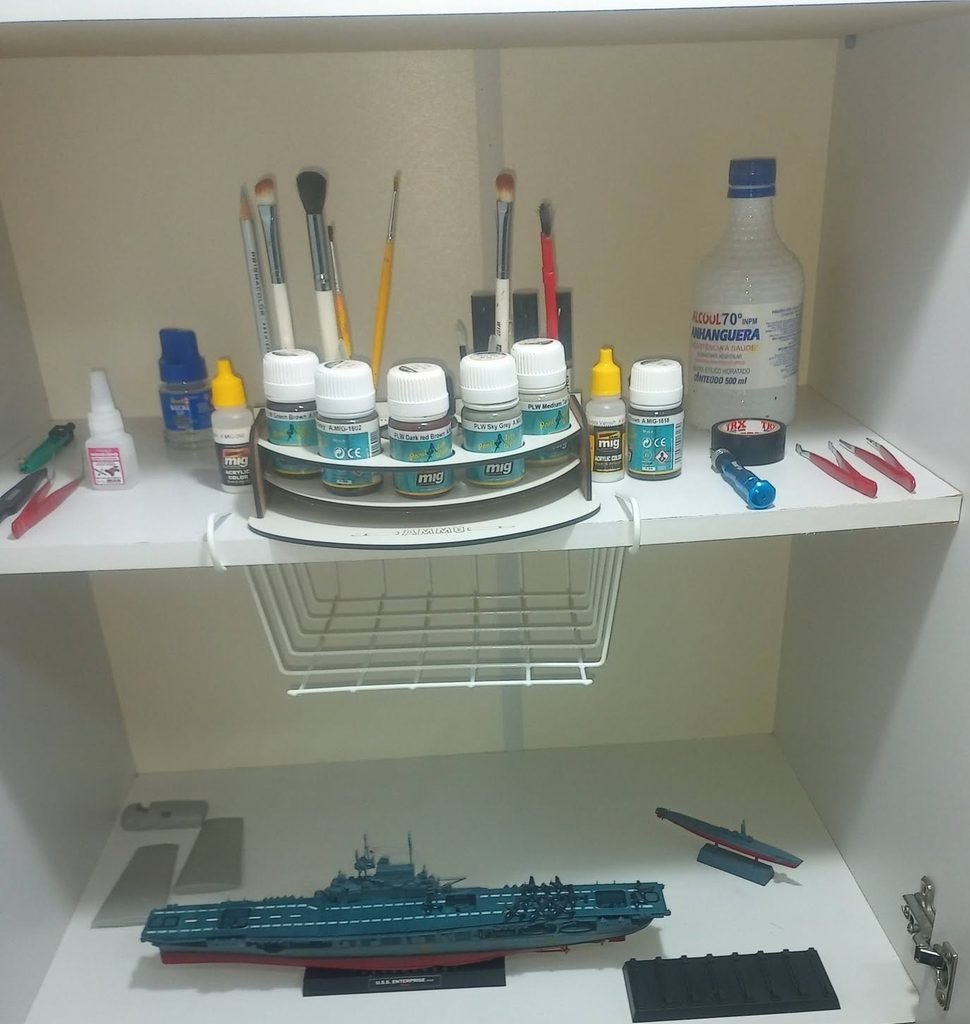
The modeling workbench (Source: Personal archive/Christian O. Schoch)
USS Enterprise (CV-6): An Icon of the Pacific War
The historical importance of the USS Enterprise is central to the appeal of this model. Commissioned in 1938, the carrier belonged to the Yorktown-class, a group of American aircraft carriers developed during the interwar period. Ships of this class represented an important stage in the evolution of carrier-based naval warfare, as aircraft increasingly became essential to reconnaissance, fleet defense, and offensive operations at sea.
During the Pacific War, the Enterprise participated in numerous operations against Japanese forces. Its long service record made it one of the most distinguished American carriers of the conflict and contributed to its reputation as one of the most important ships in U.S. naval history.
The carrier’s significance extends beyond its physical design. Its flight deck represented a mobile aviation platform from which aircraft could be launched, recovered, serviced, and prepared for subsequent missions. The relationship between the ship and its embarked aircraft was fundamental to its combat effectiveness.
For scale modelers, this combination of naval architecture and aviation history provides an unusually rich subject. The flight deck, island structure, hull, elevators, and aircraft can all contribute to a display that communicates the operational character of a wartime carrier.
The Meng PS-005 offers a compact way to explore this subject through scale modeling while providing a recognizable representation of an iconic American warship.
Full-Hull or Waterline: Choosing the Best Display
One of the kit’s most useful features is the option to build the model in either a full-hull or waterline configuration. These alternatives allow the builder to select a presentation that best suits the available display space and the intended purpose of the finished model.
A full-hull model displays the ship’s hull in its entirety, including the portion that would normally remain below the water. This configuration is particularly suitable for collectors who prefer a traditional ship model mounted on a display base. It also allows the vessel to be presented as an individual subject, with attention directed toward its overall proportions and silhouette.
A waterline model, by contrast, represents the ship as it appears at the surface of the sea. This arrangement can be especially effective in a diorama, where the carrier may be positioned alongside other warships or surrounded by a modeled ocean surface.
The choice also influences the visual character of the completed project. A full-hull presentation emphasizes the ship as a physical object, while a waterline arrangement can suggest an operational scene and provide a stronger sense of context.
Both options are appropriate for a historically themed collection. The most suitable configuration depends on whether the modeler prioritizes a standalone display or a broader naval scene.
Aircraft Included: Bringing the Flight Deck to Life
Aircraft are essential to the identity of an aircraft carrier, and the Meng PS-005 includes a selection of 1/700 scale aircraft associated with American naval aviation.
The Douglas SBD Dauntless was a carrier-based dive bomber that became one of the best-known American aircraft of the Pacific War. Its role in naval strike operations makes it a natural subject for a carrier model representing this period.
The Douglas TBD Devastator represents an earlier generation of American carrier aviation. A torpedo bomber used during the opening phase of the Pacific conflict, it provides an additional historical dimension to the aircraft selection.
The Grumman F4F Wildcat was a carrier-based fighter that served as an important component of U.S. Navy aviation during the early Pacific campaigns. Its inclusion helps represent the fighter element of the carrier’s air group.
Together, these aircraft offer opportunities to create a flight deck with greater visual variety. The modeler can consider different arrangements of aircraft on the deck, taking into account the intended historical presentation and the desired balance between open deck space and displayed aircraft.
At 1/700 scale, aircraft are necessarily small, making careful handling and precise positioning important aspects of the build. Their placement can nevertheless make a substantial difference to the finished model, helping communicate the carrier’s primary function as a floating airfield.
Modelers seeking a historically specific configuration should consult appropriate references to verify the aircraft types, markings, and operational period represented in their chosen display.
Hangar Deck and Aircraft Elevator Options
The inclusion of components representing the hangar deck adds another dimension to the kit. The hangar was an important part of carrier operations, providing space for aircraft handling and servicing beneath the flight deck.
Its presence in the model offers additional possibilities for builders interested in the relationship between a carrier’s external appearance and its internal aviation facilities. Depending on the selected configuration and the builder’s presentation, these components can contribute to a more detailed representation of the ship’s working environment.
The kit also provides fixed or movable aircraft elevator options. Elevators were essential elements of carrier design because they connected the hangar deck with the flight deck, allowing aircraft to be transferred between levels.
For a scale model, these components provide opportunities to vary the final presentation. A modeler may choose an arrangement that emphasizes the uninterrupted flight deck or one that draws attention to the aircraft-handling features of the vessel.
Careful consideration of these elements during assembly can help ensure that the final display reflects the builder’s intended interpretation of the ship.
Display Possibilities and Modeling Considerations
The dimensions of the Meng PS-005 make it suitable for a variety of display environments. Its 1/700 scale is compact enough for a collection of naval subjects while still providing sufficient overall presence to make the Enterprise a focal point.
The included display base provides a straightforward option for presenting the completed model. For collectors who prefer a more elaborate arrangement, the waterline configuration may also serve as the starting point for a maritime diorama.
A diorama can introduce additional context through the arrangement of the carrier, accompanying vessels, aircraft, and modeled water surface. Such a project can represent a general Pacific War setting or, with appropriate historical research, a more specific operational scene.
Regardless of the chosen approach, planning the final display before assembly can help determine which hull configuration and aircraft arrangement will work best.
As with any historically significant ship model, reference material is valuable when selecting colors, markings, and details. The USS Enterprise served throughout a changing period of naval warfare, and its appearance should not automatically be assumed to have remained identical throughout its career. Modelers aiming for a particular date or operation should verify the relevant configuration using reliable historical references.
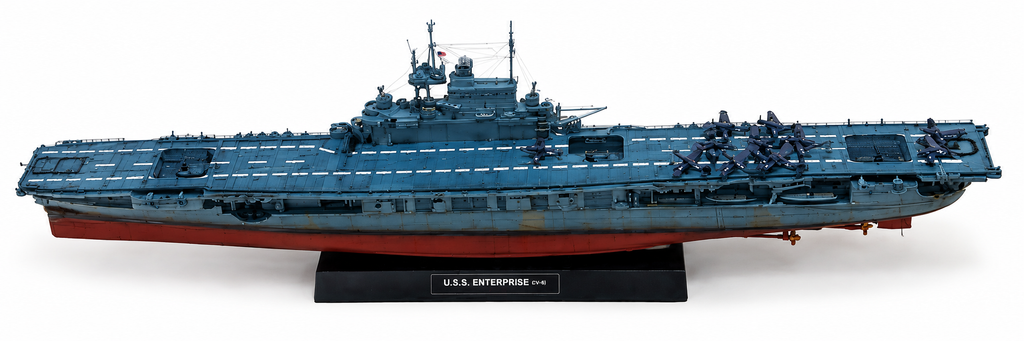
Finished scale model. (Source: Personal archive/Christian O. Schoch)
Final Assessment
The Meng Model PS-005 USS Enterprise (CV-6) in 1/700 scale offers an appealing combination of historical significance, compact dimensions, and display flexibility. Its full-hull and waterline options allow different approaches to presentation, while the included aircraft, hangar-deck components, elevator options, and display base provide several elements with which to develop the finished model.
The subject itself is a major attraction. As one of the most famous American aircraft carriers of the Second World War, the Enterprise provides a meaningful connection to the development of carrier warfare in the Pacific.
For naval modelers, World War II enthusiasts, and collectors of U.S. Navy ships, the Meng PS-005 represents an opportunity to build a recognizable carrier without committing to the space requirements of a larger-scale kit. It can serve as a standalone display model or as the centerpiece of a broader naval collection.
Ultimately, the appeal of this kit lies in the combination of a legendary historical subject and the creative possibilities offered by scale modeling. With careful assembly, a considered aircraft arrangement, and suitable historical references, the USS Enterprise can become a distinctive addition to any collection devoted to the ships and aviation of the Pacific War.
References
- Scalemates – Meng Model PS-005 U.S. Navy Aircraft Carrier Enterprise CV-6
- The Modelling News – Meng’s new 1/700 scale USS Enterprise
- YouTube – Meng Model PS-005 USS Enterprise CV-6
READ MORE:
- Build Log: USS Enterprise 1945 1/700 Meng – Part 1
- Build Log: USS Enterprise 1945 1/700 Meng – Part 2
- Build Log: USS Enterprise 1945 1/700 Meng – Part 3
- Build Log: USS Enterprise 1945 1/700 Meng – Part 4
- Build Log: USS Enterprise 1945 1/700 Meng – Part 5
- Build Log: USS Enterprise 1945 1/700 Meng – Part 6
- Build Log: USS Enterprise 1945 1/700 Meng – Part 7
- Build Log: USS Enterprise 1945 1/700 Meng – Part 8
- Build Log: USS Enterprise 1945 1/700 Meng – Part 9
- Build Log: USS Enterprise 1945 1/700 Meng – Part 10
- Build Log: USS Enterprise 1945 1/700 Meng – Part 11
- Build Log: USS Enterprise 1945 1/700 Meng – Part 12
- Build Log: USS Enterprise 1945 1/700 Meng – Part 13
- Build Log: USS Enterprise 1945 1/700 Meng – Part 14
- Build Log: USS Enterprise 1945 1/700 Meng – Part 15
Thank you to all of my patrons on Patreon for your monthly support of my work. I truly appreciate it.
Patrons receive a printed copy of my book Zero Fighter Historical Society, delivered straight to your home at no additional cost.
*(Please note: this offer is not available in all countries)
Become a patron at www.patreon.com/ZeroSociety
