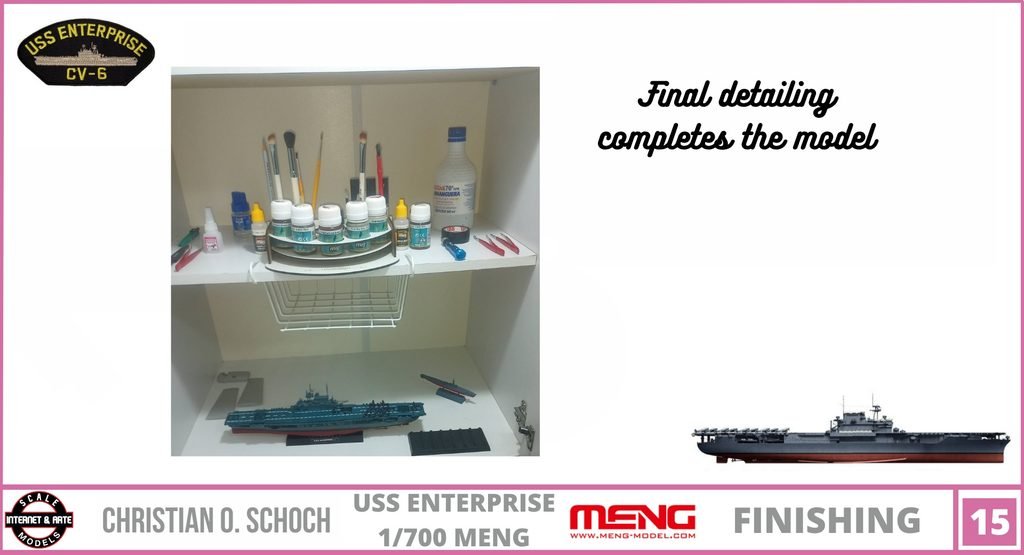
Build Log: USS Enterprise 1945 1/700 Meng – Part 15
Step 15. (Source: Personal archive/Christian O. Schoch)
Introduction: The Big E Enters the Night War
By the beginning of 1945, the aircraft carrier USS Enterprise (CV-6) had already established an extraordinary reputation in the Pacific War. One of the most decorated American warships of World War II, the legendary “Big E” had participated in numerous major naval battles and survived repeated attacks by Japanese aircraft. Yet, as the war entered its final and increasingly dangerous phase, Enterprise was about to undertake a different kind of mission: fighting through the darkness.
On December 24, 1944, Enterprise embarked Night Air Group 90, commonly identified as CVG(N)-90. The carrier became a specialized night-operations platform, designated CV(N)-6, with aircraft and crews trained to operate when darkness deprived conventional carrier aviation of many of its usual advantages.
The new air group included two principal squadrons: VF(N)-90, equipped with radar-equipped Grumman F6F Hellcat fighters, and VT(N)-90, which operated the Grumman TBM-3D Avenger. The latter became associated with the evocative nickname “Batmen,” reflecting the squadron’s connection with nighttime warfare.
For naval aviation enthusiasts and scale modelers, this combination represents one of the most distinctive chapters in Enterprise’s long combat history.
Night Air Group 90: A New Way of Fighting
Night carrier operations were among the most demanding tasks undertaken by the US Navy during World War II. Pilots had to take off and land on a moving flight deck, often in poor visibility, while navigating over dark water and coordinating with other aircraft whose positions could be difficult to establish visually.
Radar offered a solution, but it required specialized equipment, trained operators, new tactics, and extensive practice. Enterprise had already contributed to the development of carrier-based night operations before 1945. Night Air Group 90 represented a more mature effort to combine these elements into an organized combat capability.
Under Commander William I. Martin, the group undertook night patrols, interceptions, and attacks against Japanese shipping, airfields, and shore installations. Its aircraft were equipped with radar systems appropriate to their individual roles, while some Avengers also carried electronic equipment intended to locate or interfere with enemy radar installations.
The concept was straightforward but demanding: use darkness to approach enemy targets, employ electronic equipment to detect threats, and coordinate aircraft so that the carrier task force remained protected around the clock.
According to the historical account published by CV6.US, Night Air Group 90 flew more than 1,000 night sorties during its operational period. Its activities supported operations around Luzon, Formosa, the Japanese home islands, Iwo Jima, and Okinawa.
The group was not simply a collection of aircraft adapted for night flying. It was an experiment in a new style of carrier warfare, in which radar and specialized training extended the reach of naval aviation beyond daylight.
The Batmen: VT(N)-90 and the Avenger
Within Night Air Group 90, VT(N)-90 operated the TBM-3D Avenger, a night-attack development of the familiar American torpedo bomber.
The squadron’s nickname, “Batmen,” is associated with the unit in specialist aviation and modeling references. Its wartime identity also included the name “Nite Life,” associated with the squadron’s insignia. These names reflected the unusual environment in which its crews worked: darkness, limited visibility, radar contacts, and missions that often required patience before an attack could begin.
The Avenger had originally been designed for carrier-based torpedo attacks. Its spacious fuselage, long endurance, substantial payload, and three-man crew made it adaptable to several missions. In its TBM-3D configuration, the aircraft became a useful platform for night intruder operations.
Although its official squadron designation retained the traditional torpedo-bomber identity, the aircraft’s actual night missions were not limited to torpedo attacks. Avengers could carry bombs and rockets and strike shipping or installations ashore. They could also contribute to the broader night operations by detecting contacts and supporting the work of the fighter squadron.
The Avenger was not a dedicated night fighter in the same sense as the radar-equipped Hellcat. Rather, it was a versatile night-attack aircraft whose radar and crew made it particularly valuable in locating targets that could not easily be seen from the air.
TBM-3D Avenger: Radar in the Darkness
One of the most recognizable features of the TBM-3D was its radar installation on the outer portion of the right wing’s leading edge. The aircraft used the ASD-1 radar system, with its associated radome providing a distinctive external feature.
This installation helped the crew detect targets under conditions in which visual identification was difficult or impossible. The radar operator could examine the equipment’s display and communicate useful information to the pilot, helping the aircraft approach a target or maintain situational awareness during a mission.
The crew arrangement was an important advantage. While the pilot concentrated on flying, another crew member could monitor radar information and assist with navigation and target identification. The third crew member contributed to the aircraft’s other operational duties.
Some TBM-3D aircraft assigned to VT(N)-90 were modified for their night-attack role. Specialist modeling references describe the removal of the rear gun turret and the ventral defensive gun on certain aircraft to save weight. The modifications varied, so it is important not to assume that every airframe had precisely the same configuration.
These details make the TBM-3D particularly interesting as a scale-model subject. The radar radome, the altered defensive armament, and the aircraft’s distinctive camouflage help distinguish it from a conventional Avenger.
The Avenger’s Night Camouflage
The appearance of the VT(N)-90 aircraft is another reason this squadron stands out among late-war American naval aviation units.
The TBM-3D aircraft retained a version of the US Navy’s three-color camouflage scheme. This generally involved dark blue on the upper surfaces, intermediate blue on selected areas, and white on the undersides. However, aircraft adapted for night operations had their white undersides overpainted black, making them visually different from standard daytime Avengers.
The result was a striking combination of dark blue upper surfaces and a black underside. The camouflage was intended to reduce the aircraft’s visibility under nighttime conditions, although its effectiveness depended on lighting, viewing angle, weather, and the surrounding environment.
The aircraft also carried American national insignia and squadron identification markings. Because lighter markings could be conspicuous at night, some were modified or toned down. Exact details depended on the aircraft and period being represented, so photographs of the particular airframe are the best guide for reproducing its markings.
For modelers, the distinction between the original three-color scheme and the blackened underside is essential. Painting the entire aircraft glossy dark blue would miss one of the defining characteristics of many VT(N)-90 Avengers.
A restrained finish is usually the most convincing approach. The blue surfaces can show subtle tonal variation, while the black underside should remain dark without appearing like an artificial, featureless patch. At 1/700 scale, excessive contrast or heavy weathering can overwhelm the small model.
Combat Operations: Luzon, Tokyo, Iwo Jima, and Okinawa
Night Air Group 90 entered a demanding operational period as American forces advanced toward Japan.
During January 1945, Enterprise supported the campaign for Luzon in the Philippines and conducted strikes against Japanese positions and shipping. The carrier subsequently participated in operations against targets in the South China Sea and around Formosa.
On February 16–17, Enterprise aircraft took part in the major carrier strikes against the Tokyo area. These attacks marked a significant expansion of American carrier operations against the Japanese home islands. Night Air Group 90 brought its specialized capabilities to the campaign, operating under conditions in which darkness offered both opportunities and hazards.
The carrier then supported the invasion of Iwo Jima. During this period, Enterprise maintained an extraordinary tempo of flight operations. Historical accounts record 174 hours of continuous flight operations during the Iwo Jima campaign, demonstrating the intensity of the work performed by the ship and its crews.
The campaign continued toward Okinawa, where Japanese air attacks, including kamikaze strikes, posed a serious threat to the American fleet. Night Air Group 90 conducted operations against airfields and other targets that could threaten Allied forces.
Enterprise was eventually struck by a kamikaze on May 14, 1945, suffering serious damage and casualties. The carrier returned to the United States for repairs, bringing its combat career to an end.
The experience of Night Air Group 90 illustrates how the aircraft carrier’s role was changing. The ability to operate at night gave the fleet another layer of protection and allowed attacks to continue beyond the limits imposed by daylight.
Recreating the Batmen in 1/700 Scale
For a 1/700 scale model of Enterprise, the TBM-3D Avenger offers a particularly rewarding subject. Its distinctive wing-mounted radar installation, dark camouflage, and association with the Batmen make it immediately recognizable to enthusiasts familiar with naval aviation history.
A group of ten miniature Avengers can create a convincing visual impression of the squadron’s presence aboard the carrier. They can be arranged in different orientations around the flight deck, with some positioned near the elevators and others placed farther apart to suggest the movement and activity of a working flight deck.
Such an arrangement should be understood as a modeler’s interpretation rather than a precise reconstruction of a documented photograph. Night Air Group 90 also included its Hellcat fighter squadron, VF(N)-90, so a display featuring only Avengers emphasizes VT(N)-90 rather than representing the complete air group.
The small scale makes careful painting especially important. Dark blue upper surfaces, black undersides, appropriately subdued markings, and a clearly defined radar radome will communicate the aircraft’s special role without requiring exaggerated details.
The aircraft should also be viewed in the context of the ship itself. Enterprise was more than a platform from which Avengers took off and landed. It was the center of an integrated system involving flight crews, radar operators, deck personnel, maintenance teams, and the sailors who kept the carrier operating in dangerous conditions.
Conclusion: The Legacy of the Night Air Group
Night Air Group 90 represents an important step in the development of American carrier aviation. By combining radar-equipped Hellcats, specialized TBM-3D Avengers, and crews trained for nighttime operations, the US Navy expanded the carrier’s ability to defend the fleet and strike targets after dark.
The Batmen of VT(N)-90 were part of this effort. Their Avengers were not merely conventional torpedo bombers flying at night; they were adapted aircraft used in a broader system of radar-assisted night attack.
For those who build scale models, these aircraft provide an opportunity to represent a distinctive and historically significant moment in the life of USS Enterprise. The blackened undersides, wing-mounted radar, and squadron markings tell a story that goes far beyond camouflage and miniature detail.
They recall a time when American naval aviators and their crews were learning to fight in a new environment, using technology and teamwork to extend the reach of carrier aviation into the darkness of the Pacific War.
The TBM-3D Avenger of VT(N)-90 remains a fitting symbol of that achievement: a rugged aircraft adapted to a specialized mission, serving aboard one of the most celebrated carriers of World War II.
Historical References
- CV6.US — Night Air Operations
- CV6.US — 1945: USS Enterprise and Night Air Group 90
- Naval History and Heritage Command — USS Enterprise (CV-6)
- iModeler — Accurate Miniatures TBM-3D Night Intruder
- Wikimedia Commons — Seven TBM-3D Avengers of VT(N)-90, January 1945

Book: Zero Fighter Historical Society (Source: Personal archive/Christian O. Schoch)
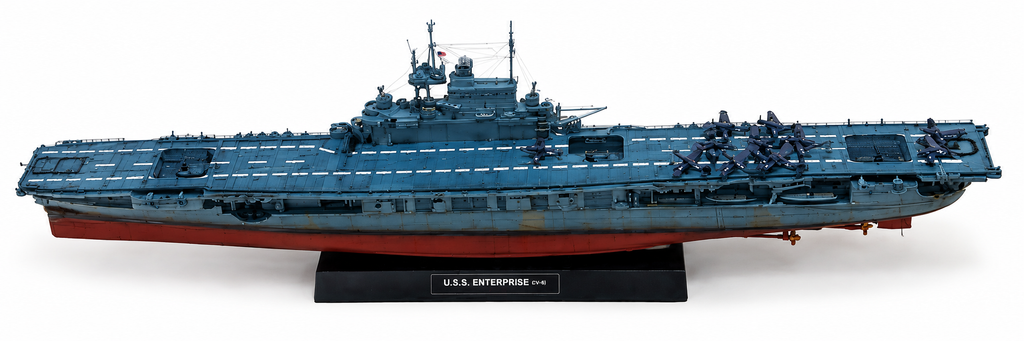
Finished scale model. (Source: Personal archive/Christian O. Schoch)
READ MORE:
- Build Log: USS Enterprise 1945 1/700 Meng – Part 1
- Build Log: USS Enterprise 1945 1/700 Meng – Part 2
- Build Log: USS Enterprise 1945 1/700 Meng – Part 3
- Build Log: USS Enterprise 1945 1/700 Meng – Part 4
- Build Log: USS Enterprise 1945 1/700 Meng – Part 5
- Build Log: USS Enterprise 1945 1/700 Meng – Part 6
- Build Log: USS Enterprise 1945 1/700 Meng – Part 7
- Build Log: USS Enterprise 1945 1/700 Meng – Part 8
- Build Log: USS Enterprise 1945 1/700 Meng – Part 9
- Build Log: USS Enterprise 1945 1/700 Meng – Part 10
- Build Log: USS Enterprise 1945 1/700 Meng – Part 11
- Build Log: USS Enterprise 1945 1/700 Meng – Part 12
- Build Log: USS Enterprise 1945 1/700 Meng – Part 13
- Build Log: USS Enterprise 1945 1/700 Meng – Part 14
- Build Log: USS Enterprise 1945 1/700 Meng – Part 15
Thank you to all of my patrons on Patreon for your monthly support of my work. I truly appreciate it.
Patrons receive a printed copy of my book Zero Fighter Historical Society, delivered straight to your home at no additional cost.
*(Please note: this offer is not available in all countries)
Become a patron at www.patreon.com/ZeroSociety

