Build Log: USS Enterprise 1945 1/700 Meng – Part 6
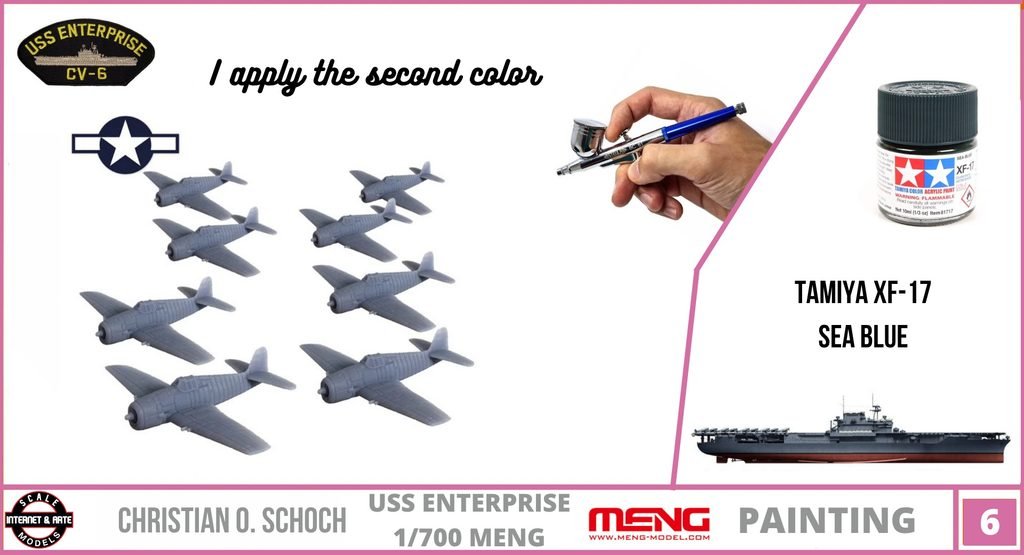
Step 6. (Source: Personal archive/Christian O. Schoch)
Introduction: The Next Step in the Painting Process
Building a scale model of a historic aircraft carrier involves much more than assembling plastic components. Painting is one of the most rewarding stages of the process because it gradually transforms a collection of miniature parts into a convincing representation of a real warship. In this sixth installment of my USS Enterprise (CV-6) modeling project, I move forward with the painting process by applying the second color to the aircraft included in the project: Tamiya XF-17 Sea Blue.
The model represents the famous American aircraft carrier USS Enterprise as she appeared during the final year of the Second World War, in 1945. The kit is the Meng Model PS-005 in 1/700 scale, a project that combines ship construction, historical research, careful painting, and the challenge of representing numerous aircraft in an extremely small scale.
In the previous stage, I applied Tamiya XF-18 Medium Blue as the first color. This initial coat established the foundation for the aircraft’s camouflage scheme and prepared the surfaces for the next step. Now, with XF-17 Sea Blue, I can begin developing the contrast between the different blue tones, bringing the miniature Avengers closer to their intended wartime appearance.
For this stage, I used an airbrush because it is a practical and efficient way to apply paint to multiple small aircraft. Although my equipment is simple, the process proved straightforward, and the aircraft were easy to paint without presenting any significant difficulties.
Why Tamiya XF-17 Sea Blue?
Choosing the appropriate paint is an important part of any historically inspired scale modeling project. When reproducing American carrier aircraft from the Second World War, blue camouflage colors deserve particular attention because they contribute significantly to the appearance of the aircraft and help distinguish the different surfaces of the camouflage scheme.
Tamiya XF-17 Sea Blue is a dark blue model paint that provides a useful option for representing deep blue tones on miniature aircraft. Its appearance contrasts with the lighter Tamiya XF-18 Medium Blue applied during the previous stage, allowing the two colors to work together visually.
The objective of this painting stage is to build the color scheme gradually rather than attempting to complete every detail in a single operation. Applying one color at a time makes it easier to control coverage, observe the relationship between the different tones, and identify areas that may require correction.
It is worth remembering that a model paint color is not automatically an exact historical match simply because its name resembles the color used on a real aircraft. Wartime finishes could vary according to paint formulation, production batches, weathering, lighting, and the condition of the original surface. Scale effect also influences how colors are perceived on a miniature.
For that reason, my choice of XF-17 should be understood within the context of this particular modeling project. I am working toward a convincing representation of the aircraft associated with the USS Enterprise in 1945, while using the paints available in my workshop and maintaining a consistent approach throughout the build.
Historical accuracy remains an important consideration, but so does the practical process of achieving a coherent finish with accessible materials and equipment.
Using an Airbrush for Greater Practicality
For this stage, I chose to use an airbrush to apply Tamiya XF-17 Sea Blue. My decision was based primarily on practicality. When painting several aircraft in 1/700 scale, an airbrush makes it easier to apply a consistent coat across multiple parts without having to paint every surface individually with a conventional brush.
The aircraft are small, and their surfaces contain relatively little room for large variations in paint thickness. An airbrush allows the paint to be distributed in fine layers, helping preserve the miniature outlines and avoiding unnecessarily heavy coats that might obscure small details.
Another advantage is the ability to maintain a similar finish across the entire group. Since the aircraft will eventually appear together on the deck of the USS Enterprise, consistency matters. Even when individual models are extremely small, differences in color coverage and surface texture can become noticeable when several examples are displayed side by side.
My equipment, however, is far from professional. I use a generic airbrush of Chinese manufacture together with a compact desktop mini compressor. These are simple tools, and they can sometimes be difficult to operate consistently. Air pressure, paint flow, cleaning, and the adjustment of the airbrush can require patience, especially when the equipment does not offer the refinements of more expensive systems.
Nevertheless, these limitations do not make the equipment useless. With careful handling, reasonable expectations, and a little persistence, it is possible to obtain satisfactory results.
That is one of the aspects I particularly appreciate about scale modeling: expensive equipment is not always necessary to make progress. Professional tools can certainly provide greater control and convenience, but a modest setup can still produce an attractive finish when the modeler understands its limitations and adapts the working method accordingly.
For this particular stage, the airbrush proved to be a practical choice. It allowed me to work through the aircraft efficiently and concentrate on the application of the second color rather than spending unnecessary time on individual brushwork.
Painting the Avengers in 1/700 Scale
One of the interesting features of this project is the inclusion of additional aircraft to create a more convincing flight deck scene. I decided to use miniature Avengers in 1/700 scale, matching the scale of the Meng Model carrier.
The Grumman TBF/TBM Avenger was an important American torpedo bomber during the Second World War. These aircraft operated from U.S. Navy carriers and performed a variety of missions, including torpedo attacks, bombing, reconnaissance, and anti-submarine operations.
Their presence on a model of the USS Enterprise helps communicate the operational character of the ship. An aircraft carrier is not simply a large warship with a flat deck; its identity is closely connected to the aircraft it carries and the missions those aircraft perform.
At 1/700 scale, however, painting these machines requires a different approach from painting aircraft in larger scales. Tiny components leave little room for elaborate techniques, and excessive detailing can become counterproductive. The goal is to achieve a clear, recognizable finish that works at the intended viewing distance.
Fortunately, the Avengers are very easy to paint at this stage of the project. Their small size makes handling and painting manageable, and the application of XF-17 Sea Blue did not create any significant problems.
Using the airbrush made the task even more practical. I could concentrate on applying the color evenly and moving from one aircraft to the next without having to treat each miniature as a complicated individual painting project.
There was no need to introduce unnecessary complexity. The basic process was straightforward: prepare the aircraft, apply the paint carefully, inspect the coverage, and allow the finish to dry before moving on to the next stage.
This simplicity is especially welcome when working with a group of small aircraft. A method that is efficient for one miniature becomes even more valuable when repeated across several examples.
Maintaining Control When Working with Small Models
Although painting these aircraft was relatively easy, working in 1/700 scale still requires attention. The small size of each component means that a little excess paint can have a greater visual impact than it would on a larger model.
The most useful approach is to work patiently and avoid trying to achieve complete coverage in a single heavy pass. Light, controlled applications help maintain a more consistent finish and reduce the risk of obscuring delicate shapes.
It is also important to remember that paint behaves differently depending on the equipment, the working conditions, and the product’s preparation. Tamiya paints should be handled according to the manufacturer’s recommendations, and the appropriate thinner and working conditions should be selected for the particular application method.
With a basic airbrush and a small compressor, it is particularly useful to test the paint flow before beginning the actual painting session. This makes it easier to recognize whether the equipment is delivering a consistent spray and to adjust the technique if necessary.
I also prefer to keep the process uncomplicated. The aircraft do not need to receive every possible weathering effect or decorative detail at this point. First, I want to establish the principal colors and create a consistent base for the remaining finishing work.
Once the paint has dried, the aircraft can be inspected under good lighting. This allows me to identify any missed areas, uneven coverage, or minor imperfections that might need attention before the next stage.
The important lesson is that simple equipment and a straightforward painting method can work well together. The key is not to fight the limitations of the tools but to work within them.
Bringing the USS Enterprise Flight Deck to Life
The aircraft are an essential part of the overall appearance of the USS Enterprise. Even a beautifully assembled carrier can look incomplete if its flight deck lacks the visual activity associated with naval aviation.
Adding Avengers in the correct scale helps create a sense of operational purpose. Their arrangement on the deck will contribute to the composition of the finished model, giving the viewer a better impression of how aircraft occupied the available space aboard a wartime carrier.
Color also plays a significant role in this presentation. The contrast between XF-18 Medium Blue and XF-17 Sea Blue introduces variation into the aircraft’s appearance, helping distinguish different areas of the camouflage scheme.
At the same time, I want the aircraft to remain visually coherent with the ship. The deck, island, hull, and aircraft will eventually form a single composition, so the painting choices made at this stage must work alongside the other colors and finishes planned for the carrier.
This is one reason why I prefer to approach the project in clearly defined stages. Each step contributes something specific to the finished model, and the gradual process makes it easier to evaluate the results before proceeding.
The second coat of blue may appear to be a relatively small development, but it represents another important step toward completing the aircraft group and integrating it into the larger project.
Conclusion: A Simple and Effective Painting Stage
Applying Tamiya XF-17 Sea Blue was a straightforward and satisfying stage in the construction of my 1/700 scale USS Enterprise (CV-6). Following the initial application of XF-18 Medium Blue, the darker blue introduced another element of the intended color scheme and helped move the miniature aircraft closer to their final appearance.
For this task, I used a generic Chinese-made airbrush and a compact desktop mini compressor. Although this equipment can sometimes be challenging to operate, it remains useful for practical modeling work. The decision to use an airbrush was based on convenience and consistency, particularly when painting several aircraft in the same session.
Most importantly, the Avengers themselves presented no significant difficulties. Their small size made the painting process manageable, and there was no need to complicate a task that could be completed with a simple, methodical approach.
This stage also reinforces one of my favorite aspects of scale modeling: satisfactory results are possible without an elaborate workshop or expensive equipment. Careful preparation, patience, and a clear understanding of the objective can make a considerable difference.
The USS Enterprise project continues to develop one step at a time. With the second blue color applied, the aircraft are progressing toward the finished appearance that will eventually bring more life and historical character to the carrier’s flight deck.
In the next stage, I will continue refining the miniature aircraft and advancing the painting process, gradually bringing together the ship, its aircraft, and the details that make this 1945 representation of the USS Enterprise such an engaging scale modeling project.
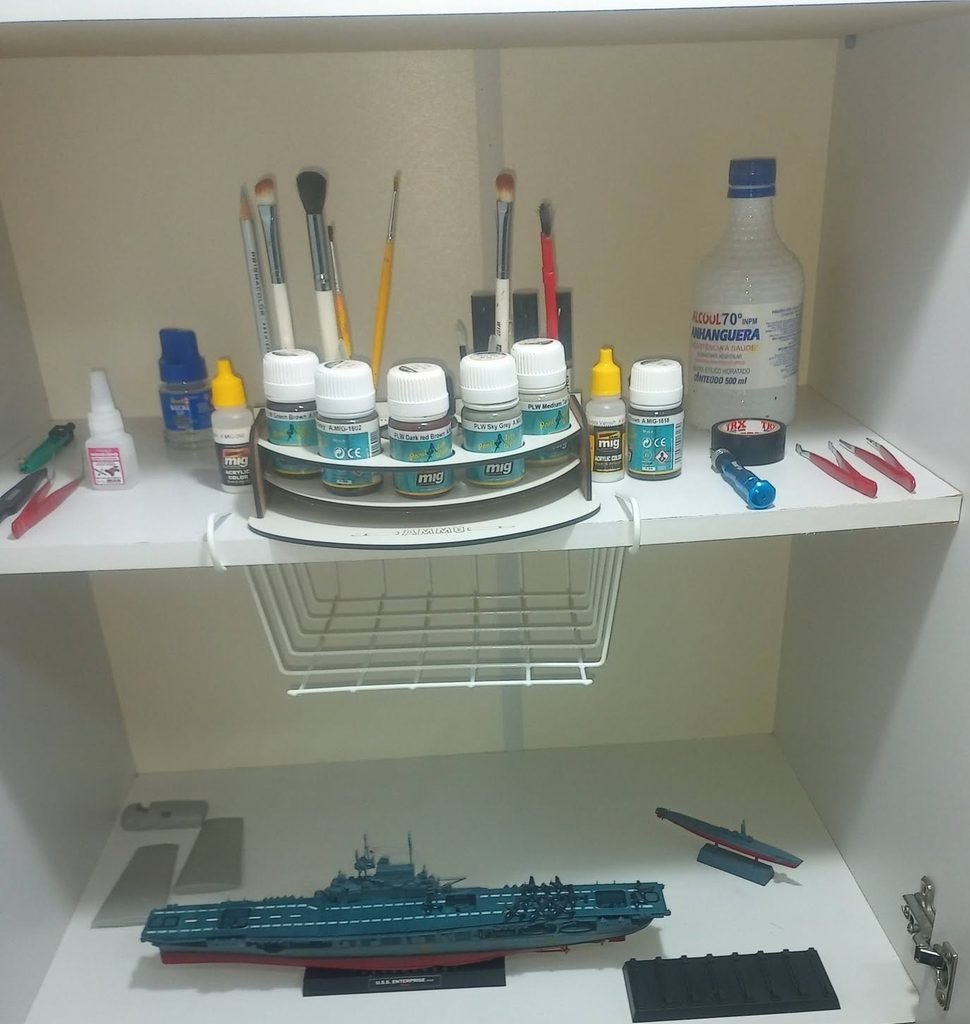
The modeling workbench (Source: Personal archive/Christian O. Schoch)
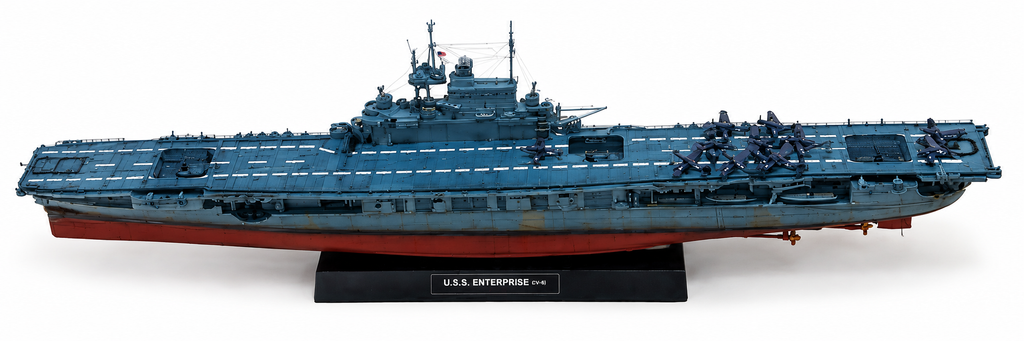
Finished scale model. (Source: Personal archive/Christian O. Schoch)
READ MORE:
- Build Log: USS Enterprise 1945 1/700 Meng – Part 1
- Build Log: USS Enterprise 1945 1/700 Meng – Part 2
- Build Log: USS Enterprise 1945 1/700 Meng – Part 3
- Build Log: USS Enterprise 1945 1/700 Meng – Part 4
- Build Log: USS Enterprise 1945 1/700 Meng – Part 5
- Build Log: USS Enterprise 1945 1/700 Meng – Part 6
- Build Log: USS Enterprise 1945 1/700 Meng – Part 7
- Build Log: USS Enterprise 1945 1/700 Meng – Part 8
- Build Log: USS Enterprise 1945 1/700 Meng – Part 9
- Build Log: USS Enterprise 1945 1/700 Meng – Part 10
- Build Log: USS Enterprise 1945 1/700 Meng – Part 11
- Build Log: USS Enterprise 1945 1/700 Meng – Part 12
- Build Log: USS Enterprise 1945 1/700 Meng – Part 13
- Build Log: USS Enterprise 1945 1/700 Meng – Part 14
- Build Log: USS Enterprise 1945 1/700 Meng – Part 15
Thank you to all of my patrons on Patreon for your monthly support of my work. I truly appreciate it.
Patrons receive a printed copy of my book Zero Fighter Historical Society, delivered straight to your home at no additional cost.
*(Please note: this offer is not available in all countries)
Become a patron at www.patreon.com/ZeroSociety
