Build Log: USS Enterprise 1945 1/700 Meng – Part 3
Step 3. (Source: Personal archive/Christian O. Schoch)
Taking the USS Enterprise Diorama to the Next Level
A scale model of a historic aircraft carrier can be impressive on its own, but presenting it in a carefully designed maritime setting can transform the entire experience. The ocean surrounding the ship, the aircraft arranged across its flight deck, and the relationship between these elements all contribute to the realism and atmosphere of a naval diorama.
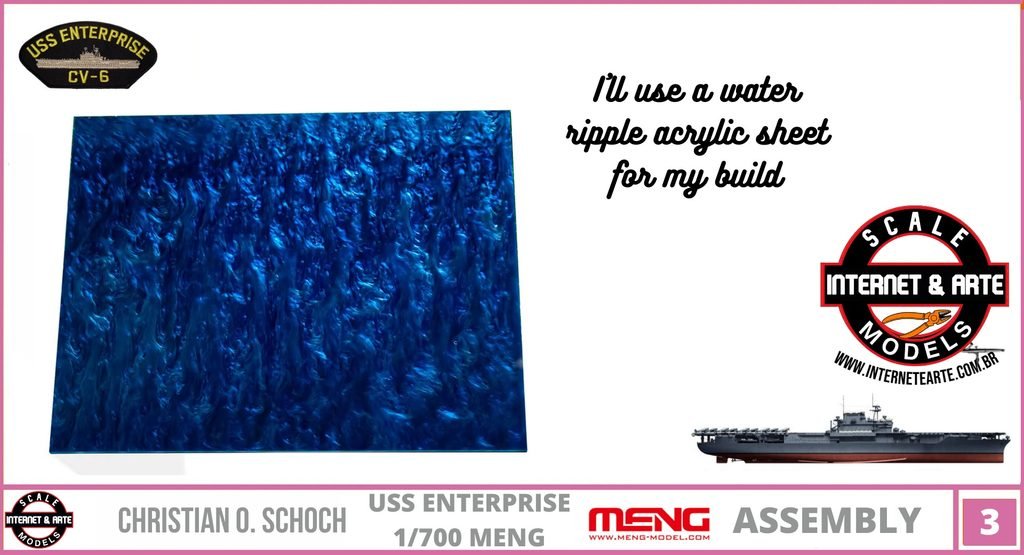
In Slide 3 of my USS Enterprise (CV-6) modeling project, I introduce two important additions that will help bring my 1/700-scale representation of the legendary American aircraft carrier to life. The first is a wavy acrylic display base intended to simulate the surface of the Pacific Ocean. The second is a set of twelve 3D-printed Grumman Avenger aircraft, purchased in the same 1/700 scale as the ship.
These additions represent more than accessories. They are part of a broader effort to create a convincing visual presentation of the Enterprise in 1945, a year that marked both the final chapter of her extraordinary wartime career and her transition into the postwar period.
For this project, my objective is to combine the historical character of the ship with the visual depth of a maritime display, while making the most of the limited space available in 1/700 scale.
The Ocean Base: Creating a Maritime Setting
One of the most important decisions when building a ship model is determining how it will be displayed. A conventional flat stand can present the vessel effectively, but it does not necessarily communicate the environment in which the real ship operated.
An aircraft carrier such as the USS Enterprise was designed to function as part of a vast naval force operating across the Pacific. Its natural setting was the open sea, where the movement of the water, the changing light, and the enormous distances between landmasses helped define the experience of naval warfare.
To reproduce at least part of that atmosphere, I purchased an acrylic base with a wavy surface designed to imitate the ocean.
The textured surface offers an interesting alternative to a completely flat display. Its undulations can introduce variations in reflected light and create the impression of a water surface surrounding the hull. Depending on the lighting and the final presentation, these irregularities may also produce subtle shadows that help distinguish the model from its background.
This is particularly valuable for a 1/700-scale carrier, whose dimensions are already substantial compared with those of many other ship models.
The goal is not simply to place the Enterprise on a blue surface. It is to establish a visual connection between the ship and the ocean, allowing the viewer to perceive the carrier as a vessel operating in its natural environment rather than as an isolated miniature.
Why Surface Texture Matters
At small scales, texture plays an important role in how a model is perceived.
Real ocean water is rarely a perfectly uniform surface. Depending on the weather, wind, and sea conditions, it can display gentle undulations, irregular reflections, and changing shades of blue and gray.
A wavy acrylic base offers a practical starting point for suggesting these characteristics without requiring the construction of a completely handmade sea.
Its effectiveness will depend on several factors, including the color of the material, the intensity of the surface texture, the surrounding lighting, and the contrast between the water and the ship’s hull.
An overly pronounced texture could compete visually with the model, while a more restrained pattern may provide an effective background that emphasizes the carrier’s long hull and broad flight deck.
For this reason, I intend to treat the base as an integral part of the presentation rather than as a simple support. The relationship between the acrylic surface and the model will be essential to the final appearance.
The ship must remain the main subject, while the ocean provides the context that makes the scene more convincing.
The USS Enterprise in 1945: A Ship with an Extraordinary History
The choice of 1945 gives this project a particularly interesting historical dimension.
The USS Enterprise, designated CV-6, was a Yorktown-class aircraft carrier commissioned into the United States Navy in May 1938. During World War II, she participated in numerous major Pacific operations and became one of the most distinguished American warships of the conflict.
Known affectionately as the Big E, the carrier earned 20 battle stars for her World War II service, a remarkable record that reflects the extent of her operational involvement. Her history includes the battles of the Eastern Solomons, Santa Cruz Islands, and the Philippine Sea, as well as operations around Iwo Jima and Okinawa. Source: Naval History and Heritage Command
By 1945, the Enterprise had evolved into a specialized night carrier operating with Night Air Group 90. Its aircraft and crews participated in operations against Japanese targets, including strikes on the Japanese home islands and missions supporting the campaign for Okinawa.
The ship was damaged by Japanese aircraft on several occasions during this final phase of the war. Following a severe kamikaze attack on May 14, 1945, she returned to the United States for repairs, ending her combat career before Japan’s surrender.
Later that year, the Enterprise returned to active service in a different capacity, helping transport American servicemen home. She arrived in New York Harbor in October 1945, where she participated in the celebrations surrounding Navy Day.
These events make 1945 a fascinating period to explore through scale modeling. The Enterprise was still a formidable symbol of American naval power, but her role was changing as the war approached its conclusion.
For my model, this historical background provides the context for the ship’s appearance and the aircraft selected to accompany it.
Twelve 3D-Printed Grumman Avengers in 1/700 Scale
The second major addition introduced in Slide 3 is a set of twelve Grumman Avenger aircraft, produced using 3D printing and purchased in the same 1/700 scale as the carrier.
Aircraft are essential to the identity of an aircraft carrier. Without them, even a beautifully assembled model can lose some of the visual character that distinguishes a carrier from other large warships.
The Avengers will help address this by adding another layer of detail to the flight deck and reinforcing the Enterprise’s role as an operational aviation platform.
The Grumman TBF Avenger first entered combat during the Battle of Midway in June 1942. It subsequently became the U.S. Navy’s standard torpedo bomber and was employed in several other roles, including reconnaissance, antisubmarine warfare, and close air support. Aircraft produced by General Motors received the designation TBM. Source: National Naval Aviation Museum
The aircraft was a substantial machine for a single-engine naval bomber, featuring a three-person crew, a powerful radial engine, and a large internal weapons bay.
Its folding-wing arrangement was especially useful aboard aircraft carriers, where hangar space and flight-deck area had to be managed carefully. Folding the wings reduced the space occupied by each aircraft, allowing more machines to be accommodated in a limited area.
At 1/700 scale, these characteristics become challenging to reproduce in miniature. Fine details are necessarily reduced, and the aircraft’s overall silhouette becomes more important to its recognition.
This is one reason I chose 3D-printed models for the project. They offer an opportunity to add twelve aircraft without having to build and detail each miniature from a conventional plastic kit.
The number is also significant for the composition. Twelve aircraft provide flexibility when arranging the flight deck, making it possible to explore different groupings and orientations while retaining a consistent scale.
Rather than treating the aircraft as isolated decorative pieces, I want them to contribute to the overall visual organization of the carrier.
Why Scale Consistency Is Essential
One of the fundamental principles of convincing scale modeling is maintaining consistent proportions between the main subject and its accessories.
A 1/700-scale ship surrounded by aircraft in a different scale can immediately lose some of its visual credibility. Even small differences in size become noticeable when several aircraft are positioned together on the same flight deck.
By purchasing Avengers in 1/700 scale, I can maintain the intended relationship between the aircraft and the Enterprise.
The real Avenger had a wingspan of approximately 54 feet 2 inches. At 1/700 scale, this corresponds to roughly 23.6 millimeters. Its actual length of approximately 40 feet 11 inches becomes about 17.8 millimeters in the same scale.
These dimensions illustrate just how small the finished miniatures are. Each aircraft must convey the distinctive Avenger profile within a space measuring less than a few centimeters.
The challenge is therefore not simply to add more aircraft, but to make the most of the details that remain visible at this scale.
The shape of the wings, the position of the cockpit, the proportions of the fuselage, and the overall arrangement of the aircraft will all influence the final impression.
With twelve Avengers, the repeated shapes will also create a recognizable visual rhythm across the flight deck.
Planning the Flight Deck Composition
Adding aircraft to an aircraft carrier model requires more consideration than filling every available space.
The flight deck is a working environment, and its appearance depends on the relationship between parked aircraft, operating areas, and the ship’s other structural features.
For my Enterprise, the twelve Avengers will need to be arranged with care so that they complement the carrier rather than overwhelm it.
Their positions will influence how the viewer’s eye moves across the model. A carefully distributed group can emphasize the length of the flight deck, while a more concentrated arrangement can draw attention to a particular section of the ship.
I also want to preserve the visibility of the carrier’s deck markings and structural details. These features are important to the identity of the Enterprise and should remain visible wherever possible.
The final arrangement will be guided by the physical space available on the model and by historical references appropriate to the specific 1945 configuration I am representing.
One important distinction is that an aircraft carrier’s aircraft complement changed according to the period, air group, and mission. The twelve Avengers are a modeling choice for this project, not a claim that twelve identical aircraft formed the ship’s complete operational complement at a particular moment in 1945.
That distinction matters to me because an effective diorama should balance visual appeal with historical awareness.
Bringing the Ship and Ocean Together
The acrylic base and the twelve Avengers serve different purposes, but their combined effect should be greater than the sum of the individual additions.
The ocean base establishes the setting. It provides a visual foundation that suggests the open Pacific and separates the ship from an ordinary tabletop display.
The aircraft, meanwhile, introduce activity and scale. They help communicate the operational purpose of the Enterprise and provide additional points of interest for anyone examining the model closely.
Together, these elements should create a more complete presentation of the carrier.
Lighting will also influence the final result. Reflections across the acrylic surface may emphasize the waves, while the shadows cast by the hull and aircraft can help establish a sense of depth.
The key will be maintaining balance. The sea should not distract from the ship, and the aircraft should enhance the flight deck without obscuring too much of its detail.
This is one of the pleasures of building a large naval subject in 1/700 scale: the model is small enough to be displayed conveniently, yet large enough to accommodate an impressive amount of historical and visual information.
Conclusion: Two Additions, One Larger Vision
Slide 3 marks an important stage in the development of my USS Enterprise (CV-6) project.
The purchase of the wavy acrylic base introduces the foundation for a more convincing maritime display, while the twelve 3D-printed Avengers will bring additional aviation detail to the flight deck.
Neither addition changes the identity of the model itself. Instead, both help strengthen the relationship between the ship, its aircraft, and the environment in which it operated.
My objective is to present the Enterprise not merely as a miniature reproduction of a historic warship, but as a carefully considered scale-modeling project inspired by the ship’s extraordinary service in World War II.
The 1945 setting provides the historical framework, the ocean base establishes the scene, and the Avengers add another dimension to the carrier’s appearance.
As the project progresses, these elements will come together to create a display that reflects both the engineering of the original vessel and the craftsmanship involved in representing it at 1/700 scale.
For me, that is what makes naval scale modeling so rewarding: every carefully chosen component contributes to a larger story, allowing a small model to evoke the scale, complexity, and history of a real warship.
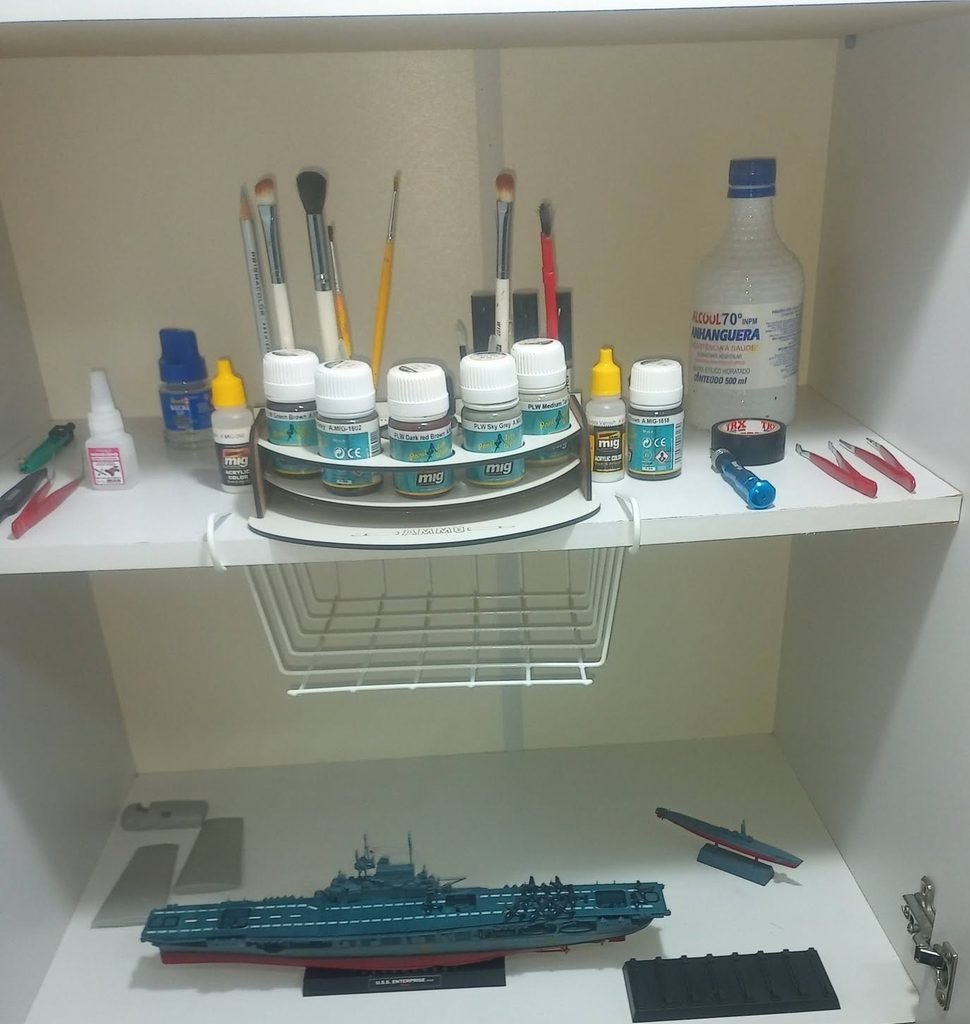
The modeling workbench (Source: Personal archive/Christian O. Schoch)
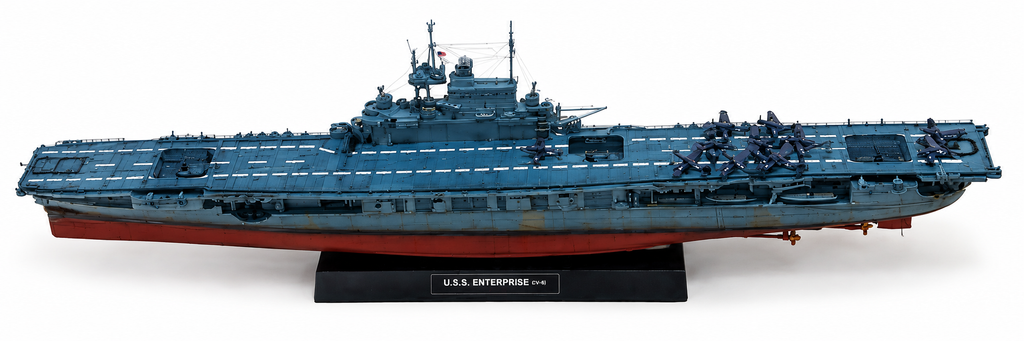
Finished scale model. (Source: Personal archive/Christian O. Schoch)
READ MORE:
- Build Log: USS Enterprise 1945 1/700 Meng – Part 1
- Build Log: USS Enterprise 1945 1/700 Meng – Part 2
- Build Log: USS Enterprise 1945 1/700 Meng – Part 3
- Build Log: USS Enterprise 1945 1/700 Meng – Part 4
- Build Log: USS Enterprise 1945 1/700 Meng – Part 5
- Build Log: USS Enterprise 1945 1/700 Meng – Part 6
- Build Log: USS Enterprise 1945 1/700 Meng – Part 7
- Build Log: USS Enterprise 1945 1/700 Meng – Part 8
- Build Log: USS Enterprise 1945 1/700 Meng – Part 9
- Build Log: USS Enterprise 1945 1/700 Meng – Part 10
- Build Log: USS Enterprise 1945 1/700 Meng – Part 11
- Build Log: USS Enterprise 1945 1/700 Meng – Part 12
- Build Log: USS Enterprise 1945 1/700 Meng – Part 13
- Build Log: USS Enterprise 1945 1/700 Meng – Part 14
- Build Log: USS Enterprise 1945 1/700 Meng – Part 15
Thank you to all of my patrons on Patreon for your monthly support of my work. I truly appreciate it.
Patrons receive a printed copy of my book Zero Fighter Historical Society, delivered straight to your home at no additional cost.
*(Please note: this offer is not available in all countries)
Become a patron at www.patreon.com/ZeroSociety
