
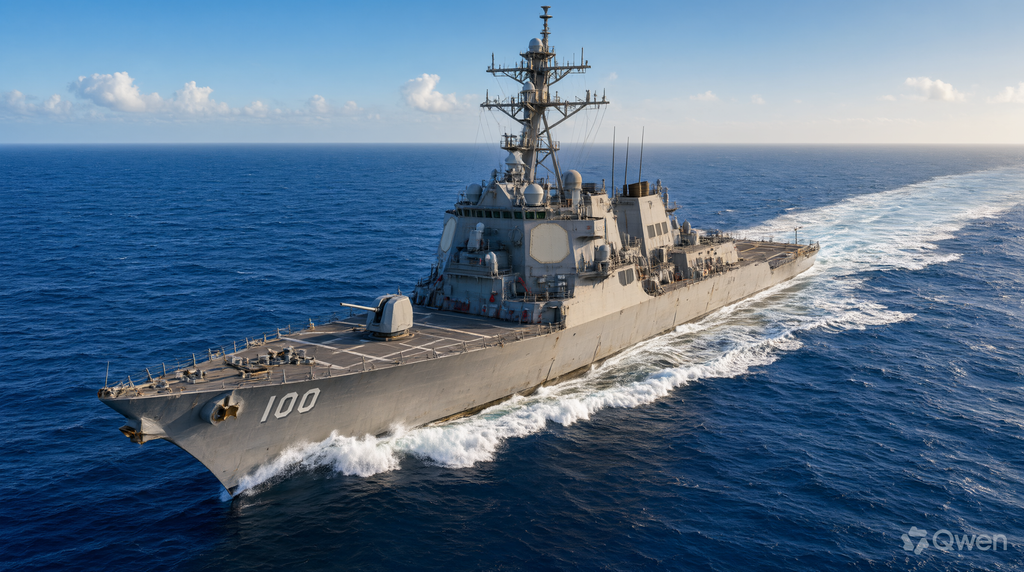
USS Kidd DDG-100 1/350 Border Models
Border Model USS Kidd DDG-100 1:350 – Building a Modern Aegis-Class Destroyer
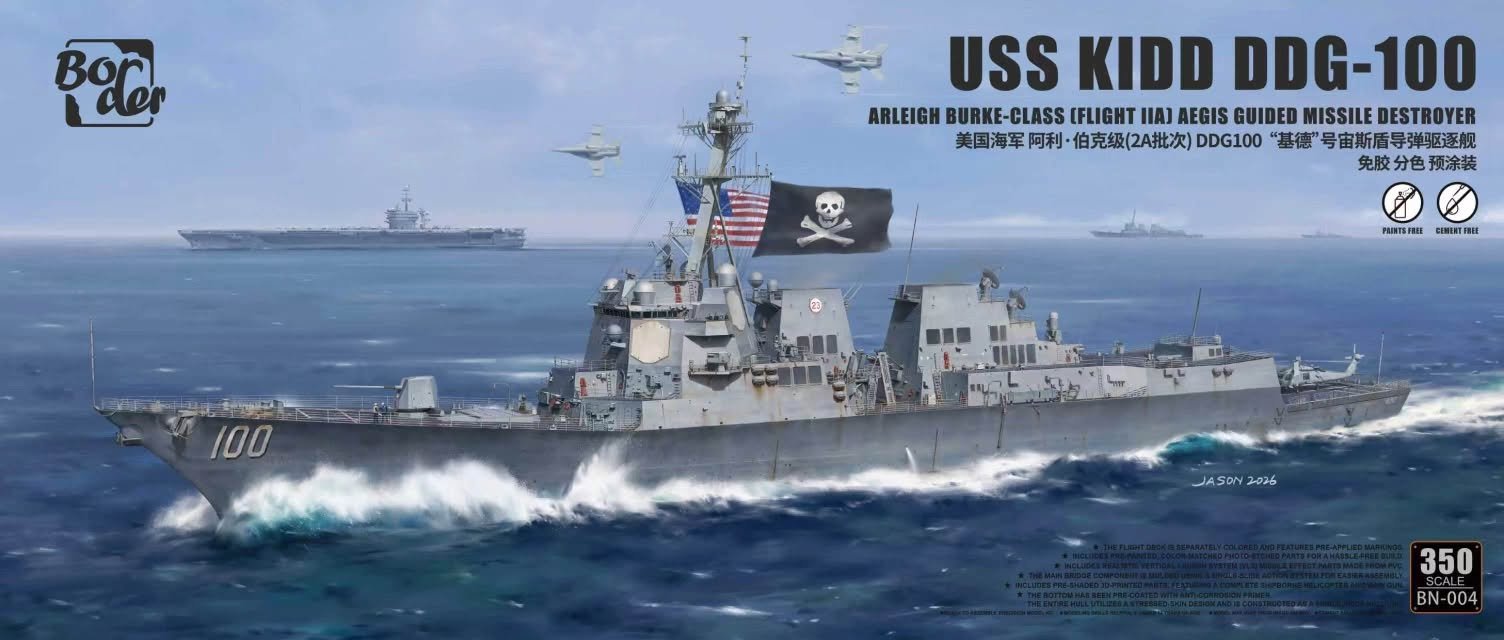
Scale Model. (Source: Image courtesy of Border Model)
Introduction: A Modern Warship in Scale Modeling
Modern naval warships offer a fascinating contrast to the battleships, cruisers, and destroyers of the Second World War. Their appearance reflects decades of technological development, with stealth-oriented superstructures, sophisticated radar systems, vertical missile launchers, and advanced combat management systems. Among these vessels, the USS Kidd (DDG-100) is an especially interesting subject for scale model enthusiasts.
Border Model brings this modern American guided-missile destroyer to the modeling world with its USS Kidd DDG-100 in 1:350 scale, reference BN-004. The kit belongs to a new generation of modeling products that combines pre-painted components, detailed photo-etched parts, and innovative construction techniques.
What makes this release particularly attractive to me is the opportunity to build a contemporary warship with a different approach from traditional plastic ship kits. Instead of concentrating exclusively on conventional assembly, painting, and finishing, Border Model introduces a product designed to simplify several stages of construction while maintaining an impressive level of visual detail.
However, the appeal of this kit goes beyond its modeling features. The USS Kidd has an interesting history, and its name carries a significant connection to one of the most dramatic moments in American naval history.
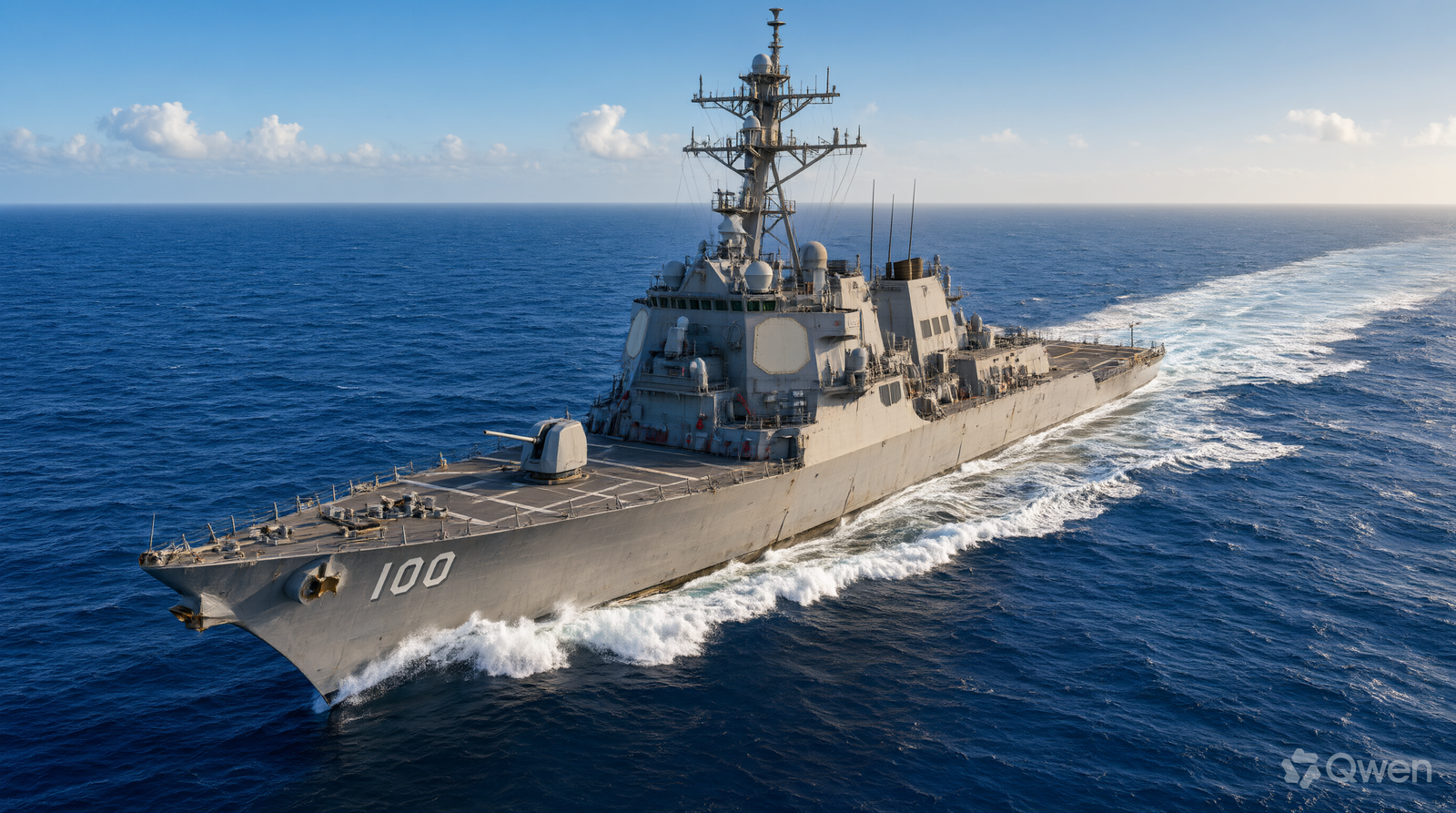
USS Kidd. (Source: Qwen Artificial Intelligence – Personal archive/Christian O. Schoch)
The History of USS Kidd DDG-100
USS Kidd is an Arleigh Burke-class guided-missile destroyer belonging to the Flight IIA configuration of this famous American warship family.
The ship was named in honor of Rear Admiral Isaac Campbell Kidd, a senior United States Navy officer who lost his life during the Japanese attack on Pearl Harbor on December 7, 1941.
Admiral Kidd was aboard the battleship USS Arizona (BB-39), where he served as Commander, Battleship Division One. During the attack, he demonstrated extraordinary courage and remained at his post while directing the response to the Japanese aircraft. He was killed when Arizona suffered catastrophic explosions and sank.
For his actions, he was posthumously awarded the Medal of Honor, becoming the first American flag officer killed in action during the Second World War.
The name Kidd had already been carried by two previous United States Navy warships. DDG-100 therefore continues a naval tradition associated with the memory and sacrifice of Admiral Kidd.
Construction of the modern USS Kidd took place at Ingalls Shipbuilding in Pascagoula, Mississippi. Her keel was laid in April 2004, and she was launched and christened on January 22, 2005. Admiral Kidd’s granddaughters, Regina Kidd Wolbarsht and Mary Kidd Plumer, participated in the christening ceremony.
Her construction was affected by Hurricane Katrina in August 2005. While undergoing final outfitting at the shipyard, the vessel suffered damage and partial flooding, requiring repairs that delayed her completion.
USS Kidd was eventually commissioned on June 9, 2007, in Galveston, Texas.
Her motto, “On to Victory,” reflects the spirit of the ship and the legacy of the officer whose name she carries.
The vessel represents a continuation of American naval power in the twenty-first century, combining advanced electronics, long-range weapons, and the ability to operate alongside carrier strike groups and other naval formations.
The Arleigh Burke-Class Flight IIA Design
The Arleigh Burke class is one of the most important modern destroyer programs in the United States Navy.
Designed around the Aegis combat system, these ships were developed to provide powerful air-defense capabilities while maintaining the ability to conduct anti-submarine, anti-surface, and land-attack operations.
The Flight IIA configuration introduced several improvements over earlier versions, particularly in aviation facilities. These ships feature a larger helicopter hangar arrangement, allowing them to operate two embarked helicopters rather than relying exclusively on a flight deck.
USS Kidd has an overall length of approximately 155 meters, a beam of around 20 meters, and a displacement of approximately 9,300 tons, depending on the reference and loading condition.
Her propulsion system consists of four General Electric LM2500 gas turbines, delivering approximately 100,000 shaft horsepower through two shafts. This arrangement allows the ship to achieve speeds exceeding 30 knots.
One of the most recognizable elements of the Arleigh Burke design is its extensive superstructure, dominated by the four fixed radar arrays of the AN/SPY-1 Aegis system.
Unlike conventional rotating radar antennas, these fixed arrays provide continuous electronic surveillance across multiple directions. This capability allows the ship to track numerous aerial and surface targets simultaneously.
The destroyer is also equipped with the Mk 41 Vertical Launching System, which accommodates different missile families depending on operational requirements and configuration.
Other systems include a 5-inch naval gun, close-in defensive weapons, torpedo launchers, electronic warfare equipment, and facilities for embarked helicopters.
This combination makes USS Kidd a remarkably versatile warship and an excellent subject for a detailed 1:350 scale model.
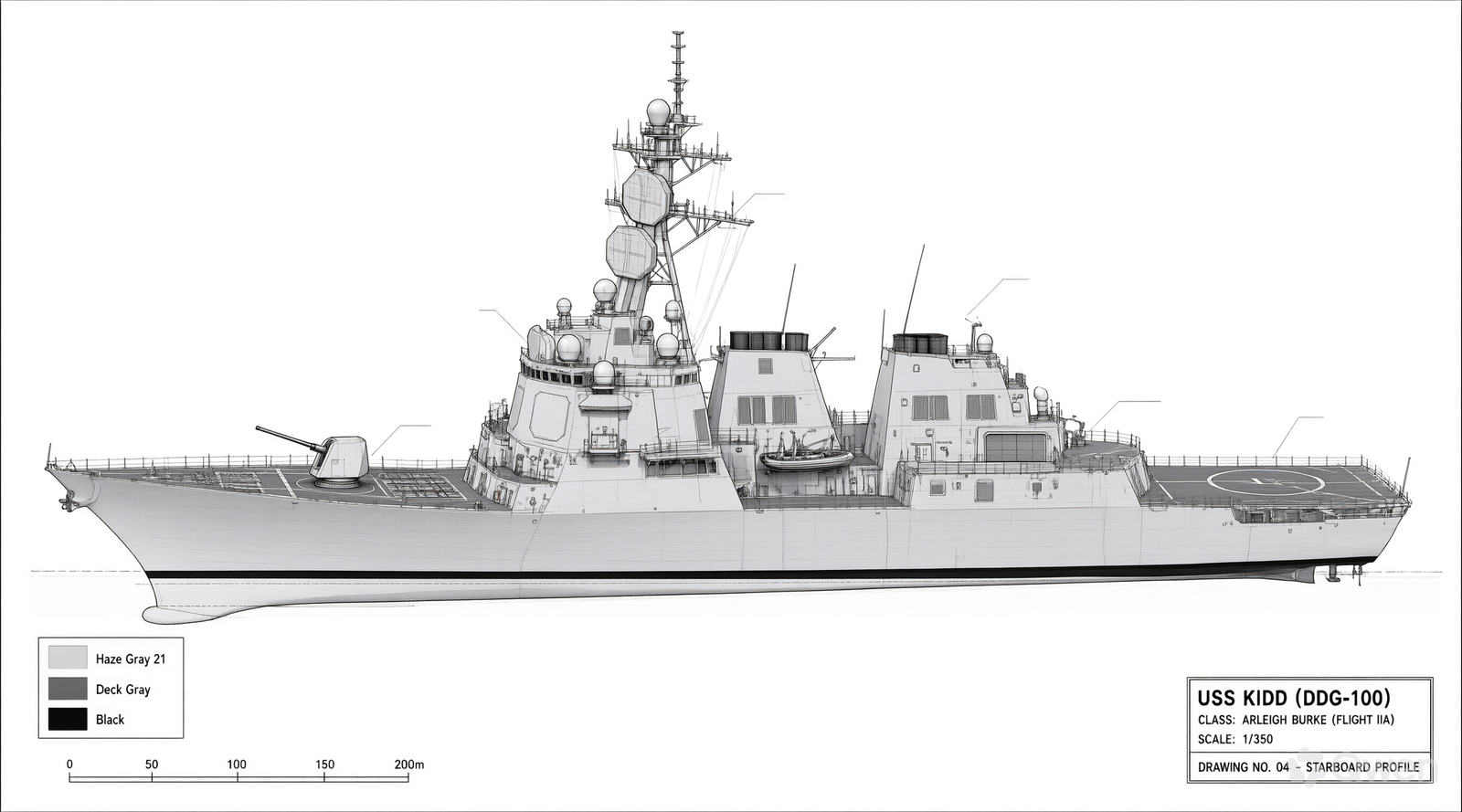
USS Kidd. (Source: Qwen Artificial Intelligence – Personal archive/Christian O. Schoch)
Border Model BN-004: Kit Features and Construction
Border Model’s USS Kidd DDG-100, reference BN-004, is designed in 1:350 scale.
The kit adopts a distinctive construction philosophy based on pre-painted, color-separated components. This is particularly interesting for modelers who appreciate detailed naval models but may prefer to reduce the amount of conventional painting required during assembly.
One of the main features is the single-piece hull, which is designed using a stressed-skin construction approach. This helps simplify the initial assembly and provides a clean foundation for the remaining components.
The lower hull comes with a pre-applied protective primer finish, while the flight deck is supplied separately with its markings already applied.
The superstructure also benefits from simplified construction. Border Model uses a single-slide molding approach for the main bridge component, reducing the number of separate pieces required in this prominent area.
Another interesting feature is the inclusion of pre-painted photo-etched parts. These components are particularly valuable for representing delicate railings and other fine structural details that would otherwise require careful painting.
The kit also includes three-dimensional printed components, including a pre-shaded helicopter and main gun assembly.
One of the most unusual additions is the inclusion of PVC missile-launch effect parts. These allow the modeler to create a more dynamic display representing missile launches from the ship’s vertical launching system.
The kit is designed to be assembled without conventional glue or painting, making it different from the traditional construction process followed by many naval modelers.
Its main characteristics include:
- Manufacturer: Border Model
- Kit reference: BN-004
- Subject: USS Kidd DDG-100
- Scale: 1:350
- Ship class: Arleigh Burke-class
- Configuration: Flight IIA
- Type: Aegis guided-missile destroyer
- Pre-painted, color-separated components
- Single-piece hull
- Pre-finished lower hull
- Flight deck with applied markings
- Pre-painted photo-etched components
- Three-dimensional printed details
- Pre-shaded helicopter and main gun
- PVC missile-launch effect components
- Simplified assembly without conventional painting or glue
These features make the kit particularly interesting for collectors who want to display a modern American destroyer without necessarily following every stage of traditional ship modeling.
My Personal Opinion: What Makes This Kit Interesting?
Personally, I find Border Model’s approach very interesting.
The idea of offering a modern warship with pre-painted components is an attractive alternative, especially when considering how complex the superstructure of an Arleigh Burke-class destroyer can be.
Modern warships contain numerous antennas, radar arrays, railings, communication systems, sensors, and other small structures. Painting these elements individually can be time-consuming, particularly when trying to maintain consistent colors and clean finishes.
For this reason, I believe the pre-painted photo-etched components are one of the most practical features of the kit.
I also appreciate the separately finished flight deck. Its markings and overall appearance are important visual elements of a modern destroyer, and having this area prepared during manufacturing can simplify construction considerably.
The three-dimensional printed helicopter and main gun are other welcome additions. These components can provide a level of definition that would be difficult to achieve with conventional molding alone.
However, I also believe that the traditional modeling experience has its own appeal. For enthusiasts who enjoy airbrushing, weathering, highlighting individual panels, and creating subtle variations in naval gray, a completely pre-painted model may offer less freedom than a conventional unpainted kit.
Personally, I would be particularly interested in how the factory finish responds to additional detailing and weathering. Modern warships may appear relatively clean compared with historical vessels, but they still show signs of operational use, including salt deposits, exhaust staining, and subtle variations in painted surfaces.
I also like the inclusion of missile-launch effects. They offer an interesting display possibility and can transform a static model into a representation of a specific operational moment.
Overall, I see the BN-004 as an interesting alternative to traditional naval modeling rather than a replacement for it.
Display Possibilities in 1:350 Scale
The 1:350 scale is particularly suitable for modern destroyers.
At this scale, the USS Kidd has enough physical presence to display its complex superstructure, radar arrays, missile-launching systems, and aviation facilities without requiring an excessively large display space.
The ship’s angular design also makes it visually distinctive. The bridge structure, mast arrangements, and large vertical radar panels create a recognizable silhouette that is quite different from the more traditional destroyers of earlier generations.
For display purposes, I believe the model would look excellent on a simple naval base with a dark ocean surface and a discreet identification plaque.
A more ambitious presentation could include the helicopter on the flight deck, additional figures, and carefully reproduced operational details.
The missile effects offer another possibility for a more dramatic presentation, although I personally appreciate the elegance of a clean, static naval display.
Conclusion: A Different Kind of Naval Modeling
Border Model’s USS Kidd DDG-100 in 1:350 scale is an interesting release that combines a historically meaningful name with the technology and appearance of a modern guided-missile destroyer.
Its pre-painted components, photo-etched details, three-dimensional printed accessories, single-piece hull, and missile-launch effects create a distinctive modeling experience.
For me, the greatest attraction is the opportunity to represent a modern Aegis destroyer while exploring a construction approach that differs from traditional plastic ship kits.
The historical background also gives this model an additional dimension. USS Kidd is not simply another modern warship. She carries the name of an admiral whose courage and sacrifice during the attack on Pearl Harbor remain part of United States Navy history.
I believe this kit is particularly appealing to naval modeling enthusiasts who want to expand their collections beyond battleships and historical destroyers and include a representative example of contemporary naval engineering.
Ultimately, the USS Kidd BN-004 demonstrates how scale modeling can bring together naval history, modern technology, and innovative manufacturing techniques in a single project.
For anyone interested in American naval aviation, surface warfare, or the evolution of modern warships, this Arleigh Burke-class destroyer offers a fascinating subject to explore and display.
READ MORE:
- Build Log: USS Enterprise 1945 1/700 Meng – Part 1
- Build Log: USS Enterprise 1945 1/700 Meng – Part 2
- Build Log: USS Enterprise 1945 1/700 Meng – Part 3
Help me keep building — book included.
The Internet & Arte is where I share every aircraft and ship I build, step by step — powered by readers like you.
Become a patron today and read my book Zero Fighter Historical Society instantly — the full ebook, directly on Patreon.
Your monthly support does three things:
- Puts the book on your screen — no shipping, no waiting
- Funds new kits, tools and step-by-step build articles
- Keeps me at the bench — whether the next build flies or floats
Become a Patron & Start Reading →
To the patrons already aboard: thank you. You’re the reason the builds keep coming.
Prefer it on your shelf? For printed copies of the book, get in touch — just send me a message on Patreon.
