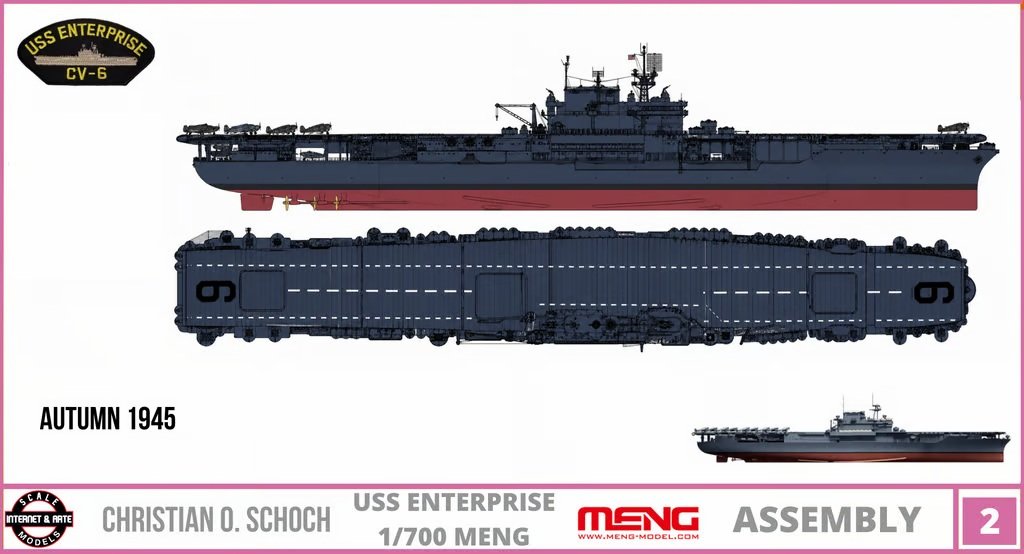
Build Log: USS Enterprise 1945 1/700 Meng – Part 2
Step 2. (Source: Personal archive/Christian O. Schoch)
USS Enterprise (CV-6) in 1945: The Final Combat Campaign of America’s Most Famous Aircraft Carrier
The legendary “Big E” in the closing months of World War II — from the battles of Iwo Jima and Okinawa to the kamikaze attacks that ended her extraordinary combat career.
By Christian O. Schoch | Internet & Arte
Introduction: A Legend in the Final Year of the War
In 1945, the USS Enterprise (CV-6) entered the final chapter of a remarkable naval career. One of the most famous aircraft carriers in American history, the Enterprise had survived years of intense combat across the Pacific, participating in nearly every major U.S. Navy carrier operation of the war. By the beginning of 1945, she was no longer simply a veteran warship. She was a symbol of American naval endurance, technological adaptability, and the determination of the men who served aboard her.
Known affectionately as the “Big E,” the Enterprise belonged to the Yorktown class, alongside USS Yorktown (CV-5) and USS Hornet (CV-8). Commissioned in 1938, she had fought at Midway, Guadalcanal, the Philippine Sea, and Leyte Gulf. Her survival through these campaigns earned her an extraordinary reputation among American sailors.
The final months of the Pacific War, however, would test the carrier in a different way. Operating against increasingly desperate Japanese defenses, the Enterprise faced dangerous air raids, kamikaze attacks, and the demanding requirements of nighttime carrier warfare. Although she continued fighting effectively, damage sustained in May 1945 ultimately brought her combat career to an end.
Her story in 1945 is therefore not only a history of military operations. It is also a study of carrier aviation, damage control, and the extraordinary efforts required to keep a heavily engaged warship operational.
1. The USS Enterprise at the Beginning of 1945
At the beginning of the year, the Enterprise was already an experienced combat veteran. Her original prewar configuration had evolved considerably through successive refits and wartime modifications. Radar installations, improved antiaircraft armament, additional electronic equipment, and changes to her flight operations reflected the rapid development of naval warfare.
Unlike newer American carriers entering the Pacific Fleet, the Enterprise had accumulated years of operational experience. Her crew understood the demands of sustained flight operations, while her aviation personnel had learned to coordinate fighters, bombers, and torpedo aircraft under difficult combat conditions.
By 1945, her most distinctive operational characteristic was her specialization in nighttime carrier operations. The ship had been assigned specially equipped aircraft and aircrews trained to operate after dark, giving the U.S. Navy an additional capability during the final offensives against Japan.
This role was particularly valuable because Japanese aircraft could threaten American task forces at night and because darkness offered opportunities to attack enemy airfields and installations when conventional carrier operations were more difficult.
The Enterprise was no longer merely another fleet carrier. She had become an important component of the Navy’s evolving nighttime warfare system.
2. Operations Against Japan and the Invasion of Iwo Jima
During January 1945, the Enterprise participated in operations against Japanese positions and shipping in the western Pacific. Her aircraft conducted nighttime fighter patrols, attacks against shore installations, and missions against enemy shipping.
The strategic situation was changing rapidly. American forces were advancing toward the Japanese home islands, while the Imperial Japanese Navy had lost much of its former ability to challenge the U.S. fleet in a conventional carrier battle.
Nevertheless, Japanese land-based aviation remained dangerous, particularly as suicide attacks became an increasingly prominent defensive tactic.
In February, the Enterprise supported Operation Detachment, the American invasion of Iwo Jima. The island was strategically important because its airfields could support operations against Japan and provide emergency landing facilities for American aircraft returning from long-range missions.
The carrier’s nighttime capabilities proved especially useful during this campaign. Her aircraft operated in support of the invasion and helped protect the fleet during periods when darkness complicated the work of conventional carrier groups.
One remarkable achievement occurred between February 23 and March 2, when the Enterprise maintained aircraft operations over Iwo Jima for approximately 174 consecutive hours, interrupted only briefly by poor weather. This demanding schedule demonstrated the operational value of specialized night carrier aviation.
The achievement also illustrates the human dimension of naval aviation. Pilots, deck crews, maintenance personnel, and flight controllers had to maintain an exhausting rhythm of operations while working under the constant threat of enemy attack.
3. Night Carrier Aviation: A Distinctive Role
The Enterprise‘s nighttime mission distinguished her from many other American carriers operating in the Pacific in 1945.
Her night air group included fighter and attack aircraft adapted for operations after dark. Night fighters provided protection against hostile aircraft, while attack aircraft conducted missions against enemy airfields, installations, and shipping.
The Grumman F6F Hellcat was among the important aircraft associated with American carrier fighter operations. The Grumman TBF/TBM Avenger, meanwhile, provided a versatile platform for attack missions. Depending on the mission and configuration, Avengers could carry bombs, torpedoes, rockets, or other ordnance.
The exact composition of an air group changed with operational requirements, aircraft losses, and personnel assignments. For this reason, historical photographs and dated squadron records are particularly valuable when reconstructing the Enterprise‘s aircraft complement at a specific moment in 1945.
Night operations demanded more than modified aircraft. Crews needed specialized training, reliable communications, effective radar coordination, and disciplined flight-deck procedures. Recovering aircraft in darkness was especially challenging because pilots had fewer visual references and had to depend more heavily on instruments, radio guidance, and landing signals.
These operations also imposed considerable pressure on maintenance teams. Aircraft had to be inspected, refueled, rearmed, and prepared for subsequent missions while the ship continued maneuvering with its escorting destroyers and cruisers.
The Enterprise‘s experience in this role represented an important stage in the development of modern carrier aviation.
4. The Okinawa Campaign and the Growing Kamikaze Threat
In March 1945, the Enterprise took part in attacks against Japanese airfields and other targets in preparation for the invasion of Okinawa. These operations were designed to weaken Japanese air power and reduce the threat to the Allied amphibious forces.
On March 18, the carrier came under attack by Japanese aircraft. Although a bomb struck near the forward elevator and caused casualties, the weapon did not detonate. The ship continued operating, but the incident demonstrated how narrow the margin between survival and disaster could be.
The following days brought further danger. During an attack on March 20, near misses caused damage, and two American 5-inch shells accidentally struck gun positions on the Enterprise, killing seven men and wounding approximately thirty others. The resulting fires threatened ammunition and aircraft aboard the ship, but the crew’s damage-control teams brought the situation under control.
The Okinawa campaign began with Allied landings on April 1. The invasion triggered a sustained Japanese effort to disrupt the American fleet through conventional air attacks and kamikaze missions.
On April 11, a Japanese aircraft struck the Enterprise near her starboard side. The impact and subsequent explosion damaged the hull and caused casualties, forcing the carrier to withdraw for repairs.
Yet the Enterprise returned to combat. Her repeated reappearances after damage reflected the importance of experienced carriers during a campaign in which American forces needed continuous air support.
5. May 14, 1945: The Attack That Ended Her Combat Career
The Enterprise‘s final combat episode occurred during the Okinawa campaign in May 1945.
On May 11, the carrier USS Bunker Hill (CV-17) was severely damaged by kamikaze attacks. Vice Admiral Marc A. Mitscher subsequently transferred his flag to the Enterprise, placing the veteran carrier in the role of flagship for the senior commander of the fast-carrier force.
The Enterprise continued supporting offensive operations against Japanese airfields, including nighttime attacks intended to reduce the number of aircraft available for suicide missions.
On May 14, however, a Japanese Mitsubishi A6M Zero, flown by Lieutenant Junior Grade Shunsuke Tomiyasu, struck the carrier during a kamikaze attack.
The aircraft hit the flight deck near the forward elevator. The impact and the explosion of its bomb caused extensive structural damage and ignited a serious fire. Fourteen American sailors were killed, and sixty-eight were wounded.
The carrier’s crew responded with rapid and determined damage-control efforts. Firefighting teams worked to contain the flames and prevent them from spreading to other parts of the ship.
An important factor was the Enterprise‘s nighttime operating procedures. Her aircraft had been defueled and disarmed, gasoline lines had been drained, and bomb-magazine hatches had been secured. These precautions reduced the danger of a catastrophic chain reaction involving aviation fuel and armed aircraft.
The fires were brought under control, but the damage was severe enough to end the carrier’s combat operations.
After the attack, the Enterprise withdrew from the combat area and eventually returned to the United States for repairs. She reached Puget Sound Navy Yard in Washington in June 1945.
Japan surrendered in August, while the veteran carrier was still undergoing repairs.
For the Enterprise, the war at sea was effectively over.
6. The Appearance of the USS Enterprise in 1945
For scale modelers, the Enterprise of 1945 presents a fascinating subject because her appearance reflected years of wartime modifications and hard service.
Her flight deck, island structure, radar equipment, antiaircraft positions, and aircraft-handling arrangements had evolved significantly from her prewar configuration. Period photographs are essential for identifying the details appropriate to a particular date.
American warships operating in the Pacific commonly wore Navy Measure 21, characterized by an overall Navy Blue appearance. However, a specific reconstruction of the Enterprise should be based on dated photographs and reliable references rather than assuming that every surface had the same finish.
The flight deck requires particular attention. Its appearance depended on the deck’s construction, protective coatings, wear, maintenance, and the effects of salt water and operational activity. Weathering should therefore be restrained and supported by photographic evidence.
The island and vertical surfaces also deserve careful study. Radar antennas, signal equipment, gun directors, rangefinders, and antiaircraft guns created a complex silhouette that changed throughout the war.
Aircraft are equally important. A model depicting the carrier during the Okinawa campaign should reflect the appropriate aircraft types and operational markings for the selected period. F6F Hellcats and TBM Avengers are particularly relevant to the ship’s late-war operations, although the exact air group and number of aircraft varied.
The ship’s hangar deck is another area of interest. Because the Enterprise was an operational warship, the interior contained structural supports, aircraft-handling equipment, workshops, machinery spaces, and other facilities essential to flight operations. Where a model allows these areas to be seen through open elevators, careful research can add considerable historical value.
Finally, the carrier’s battle damage should be treated chronologically. A model representing the ship before May 14 should not include the damage caused by that day’s kamikaze attack. Conversely, a depiction of the carrier immediately after the attack should reflect the documented damage rather than an arbitrary weathered appearance.
For a convincing historical model, the objective is not simply to reproduce a famous ship, but to capture her configuration at a clearly defined moment.
7. Legacy: The Big E and the End of the Pacific War
The Enterprise‘s combat career was among the most distinguished in the history of the United States Navy. She participated in numerous major engagements, earned twenty battle stars, and received the Presidential Unit Citation.
Her aircraft and guns contributed to the destruction of enemy aircraft and ships throughout the Pacific War. More importantly, the carrier remained operational through repeated damage, demonstrating the value of effective maintenance, damage control, and experienced personnel.
After the Japanese surrender, the Enterprise returned to service in a different capacity. She helped transport American servicemen home during Operation Magic Carpet, the large-scale repatriation effort that followed the war.
On October 17, 1945, she arrived in New York Harbor, where she later participated in Navy Day celebrations. Her wartime achievements had made her a national symbol, and large numbers of visitors came aboard to see the celebrated carrier.
Despite efforts to preserve her as a memorial, the Enterprise was ultimately sold for scrapping in 1958. Her physical disappearance was a considerable loss to naval heritage, but photographs, official records, surviving artifacts, and scale models continue to preserve her story.
Conclusion: A Carrier That Defined an Era
In 1945, USS Enterprise (CV-6) represented both the achievements and the sacrifices of American carrier warfare. Her operations around Iwo Jima and Okinawa demonstrated the growing sophistication of naval aviation, while her encounters with kamikaze attacks revealed the terrible risks faced by the men who served aboard the Pacific Fleet’s carriers.
The damage inflicted in May ended her combat career, but it did not diminish her historical importance. The Enterprise had helped shape the course of the Pacific War through years of sustained operations, technical adaptation, and determined service.
For naval historians and scale modelers alike, the 1945 Enterprise remains an exceptional subject. Her late-war configuration captures a mature aircraft carrier at the height of American naval power, while her final campaign tells a compelling story of courage, innovation, and endurance.
The “Big E” was more than a famous warship. She was a floating record of the Pacific War — and one of the most enduring legends in naval history.
Historical references
- Naval History and Heritage Command — USS Enterprise (CV-6), Dictionary of American Naval Fighting Ships
- Naval History and Heritage Command — Kamikaze Attacks on U.S. Flagships
- Naval History and Heritage Command — USS Enterprise: Historical Overview
Editorial note: The article describes the ship’s 1945 operations as a whole. For model builds representing a specific day, consult dated photographs and primary records to verify aircraft markings, camouflage, equipment, and battle damage.
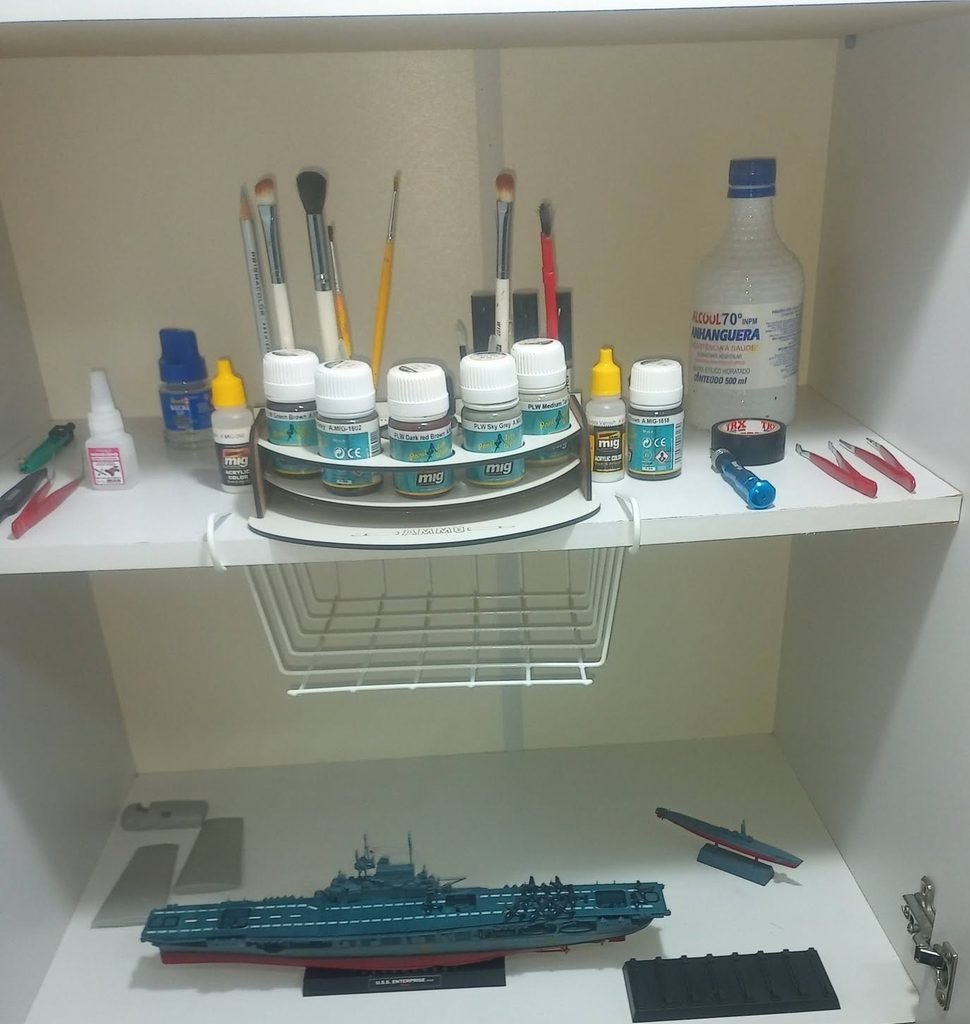
The modeling workbench (Source: Personal archive/Christian O. Schoch)
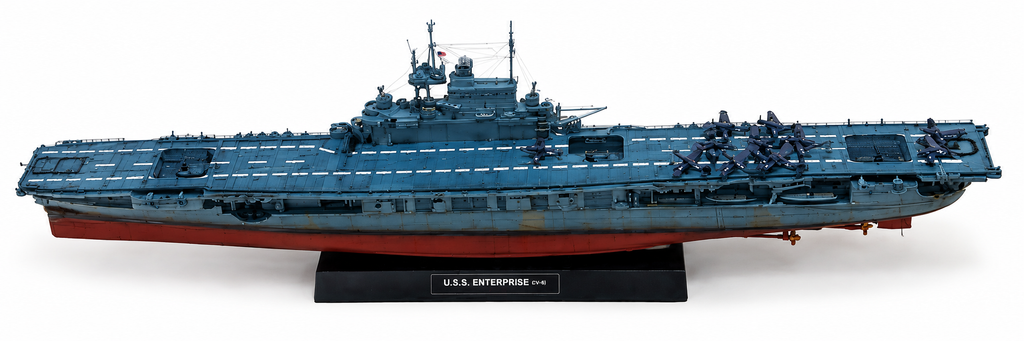
Finished scale model. (Source: Personal archive/Christian O. Schoch)
READ MORE:
- Build Log: USS Enterprise 1945 1/700 Meng – Part 1
- Build Log: USS Enterprise 1945 1/700 Meng – Part 2
- Build Log: USS Enterprise 1945 1/700 Meng – Part 3
- Build Log: USS Enterprise 1945 1/700 Meng – Part 4
- Build Log: USS Enterprise 1945 1/700 Meng – Part 5
- Build Log: USS Enterprise 1945 1/700 Meng – Part 6
- Build Log: USS Enterprise 1945 1/700 Meng – Part 7
- Build Log: USS Enterprise 1945 1/700 Meng – Part 8
- Build Log: USS Enterprise 1945 1/700 Meng – Part 9
- Build Log: USS Enterprise 1945 1/700 Meng – Part 10
- Build Log: USS Enterprise 1945 1/700 Meng – Part 11
- Build Log: USS Enterprise 1945 1/700 Meng – Part 12
- Build Log: USS Enterprise 1945 1/700 Meng – Part 13
- Build Log: USS Enterprise 1945 1/700 Meng – Part 14
- Build Log: USS Enterprise 1945 1/700 Meng – Part 15
Thank you to all of my patrons on Patreon for your monthly support of my work. I truly appreciate it.
Patrons receive a printed copy of my book Zero Fighter Historical Society, delivered straight to your home at no additional cost.
*(Please note: this offer is not available in all countries)
Become a patron at www.patreon.com/ZeroSociety
