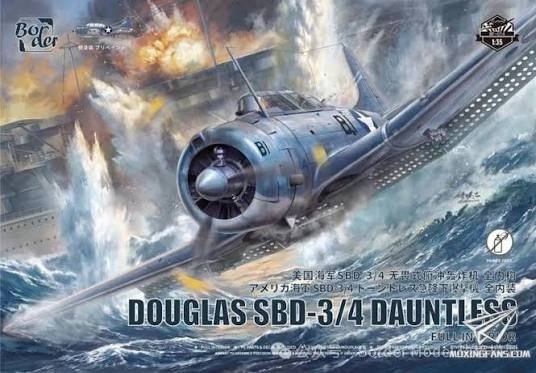
Dauntless 1/35 Border Models
Border Model 1:35 Douglas SBD-3/4 Dauntless – A New Dimension in Building an American Naval Aviation Legend
Douglas Dauntless. (Source: Image courtesy of Border Model)
Introduction: The Dauntless in a Larger Scale
Few aircraft earned a place in aviation history as significant as the Douglas SBD Dauntless. Recognized for its distinctive silhouette, rugged construction, and remarkable effectiveness as a carrier-based dive bomber, the Dauntless became one of the most important American naval aircraft of the Second World War. Its contribution to the Pacific campaign, particularly during the Battle of Midway in June 1942, established its reputation as one of the most successful dive bombers of the conflict.
For scale model enthusiasts, the Dauntless has always been an attractive subject. Its combination of a large glazed canopy, complex cockpit arrangement, perforated dive brakes, radial engine, and distinctive wing configuration offers plenty of opportunities for detailed modeling.
Border Model takes an interesting approach with its Douglas SBD-3/4 Dauntless in 1:35 scale, catalog number BG-003. Part of the manufacturer’s Chroma Series, this kit combines an unusually large aircraft scale with factory-pre-painted components and an extensive interior. It is a release that deserves attention not only because of the aircraft it represents, but also because of the different modeling experience it proposes.
The Aircraft: An Essential Pacific War Dive Bomber
The Douglas SBD Dauntless was developed as a carrier-based scout and dive bomber for the United States Navy and Marine Corps. Its design emphasized structural strength, reliable performance, and the ability to deliver bombs with considerable accuracy during steep diving attacks.
The SBD-3 and SBD-4 represented important stages in the aircraft’s development.
The SBD-3 introduced significant improvements over earlier versions, including armor protection for the crew, self-sealing fuel tanks, and a strengthened combat configuration. It was powered by the Wright R-1820 Cyclone radial engine and normally carried a substantial bomb load for its size. Its defensive armament included forward-firing machine guns and flexible guns operated by the rear gunner.
The SBD-4 followed with improvements to its electrical system, including a 24-volt installation, as well as a constant-speed propeller and refinements to its equipment. Although externally similar to the SBD-3, these modifications represented an important step in the continuous development of the Dauntless.
Both versions became closely associated with the early American carrier campaigns in the Pacific. Their combat record helped establish the Dauntless as one of the aircraft responsible for changing the strategic balance during the first years of the Pacific War.
Border Model BG-003: A Different Modeling Experience
The most immediately noticeable feature of Border Model’s SBD-3/4 is its 1:35 scale. Aircraft kits are traditionally associated with scales such as 1:72, 1:48, and 1:32, making a 1:35 Dauntless an unusual and interesting proposition.
The model has an approximate wingspan of 362 mm and an assembled length of 288 mm. These dimensions provide a substantial display presence while allowing the builder to appreciate details that would be considerably smaller in conventional 1:48 scale.
The kit belongs to Border Model’s Chroma Series, which introduces factory-pre-painted plastic components. Rather than presenting every part in conventional unpainted plastic, the manufacturer applies color to selected components before assembly.
This approach is particularly interesting when considering the extensive interior included in the Dauntless.
The kit provides a detailed cockpit and internal structure, allowing the modeler to explore areas that are often hidden or only partially visible in aircraft models. The large greenhouse-style canopy is especially important because it offers an excellent view of the crew positions and cockpit details.
Other notable features include photo-etched components, clear parts, decals for three marking options, and two types of external stores, including bombs and drop tanks. The kit also includes a detailed representation of the aircraft’s internal arrangement.
The combination of these elements makes the BG-003 more than a conventional exterior-focused aircraft model.
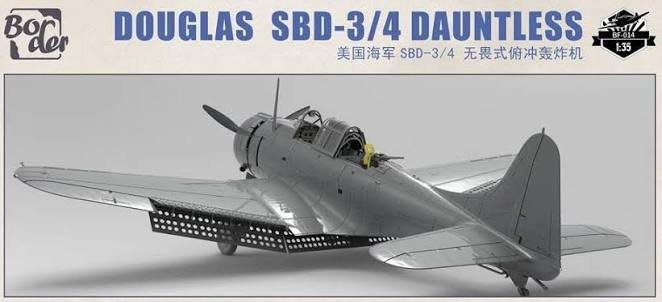
Douglas Dauntless. (Source: Image courtesy of Border Model)
The Pre-Painted Parts: Where I See the Real Advantage
One of the most distinctive aspects of this kit is its pre-painted construction. This is an interesting concept, but I believe its usefulness depends greatly on which parts are being considered.
Personally, I think factory pre-painting is a very good idea for the cockpit and canopy areas.
The cockpit of the Dauntless contains numerous small components, structural details, instrument panels, seats, and other elements that are difficult to reach once the fuselage has been assembled. Having these components already provided with a basic color finish can save considerable time and simplify the construction process.
The same concept is attractive when working around the canopy. The Dauntless has an extensive glazed enclosure, and its framework is one of the aircraft’s most recognizable visual characteristics. A suitable factory-applied finish on the relevant framing components can help establish the appearance of the canopy without requiring the modeler to begin every detail from an entirely unpainted surface.
However, my opinion changes when it comes to the external fuselage.
I do not consider pre-painted fuselage components particularly useful for my preferred modeling approach. The exterior of an operational naval aircraft is an area where I like to have complete control over the paintwork, tonal variations, weathering, and final appearance.
A factory-applied finish may become unnecessary work if the modeler intends to apply primer, recreate the camouflage or naval color scheme, introduce subtle variations between panels, and develop a convincing weathered surface.
For me, the real attraction of the Chroma concept is therefore not eliminating painting altogether. It is using pre-painted components where they provide a practical advantage while retaining the freedom to customize the most visible external surfaces.
This is an important distinction: pre-painting can be a useful starting point, but it does not necessarily replace the traditional modeling process.
Exterior Details and Modeling Opportunities
The Dauntless offers several distinctive features that make it particularly attractive to experienced modelers.
One of the most recognizable is its perforated split dive brakes. These large panels were designed to reduce the aircraft’s speed during a steep dive, allowing the pilot to maintain better control and achieve a more accurate bombing approach.
Border Model’s kit includes positionable flying surfaces and dive brakes, giving the builder the opportunity to choose an appropriate display configuration.
The radial engine is another important element. The Wright R-1820 Cyclone was a central component of the aircraft’s design, and the kit includes an engine representation with supporting structure and a choice of ignition harness configurations.
The exterior also offers plenty of opportunities for weathering. Exhaust staining, oil traces, faded paint, accumulated dirt around access panels, and wear associated with carrier operations can all contribute to a convincing final presentation.
The inclusion of photo-etched parts is welcome, particularly for thinner components that benefit from the precision of metal rather than thicker molded plastic.
The model’s large scale also provides an opportunity to work with fine details without the limitations commonly encountered in smaller aircraft kits.
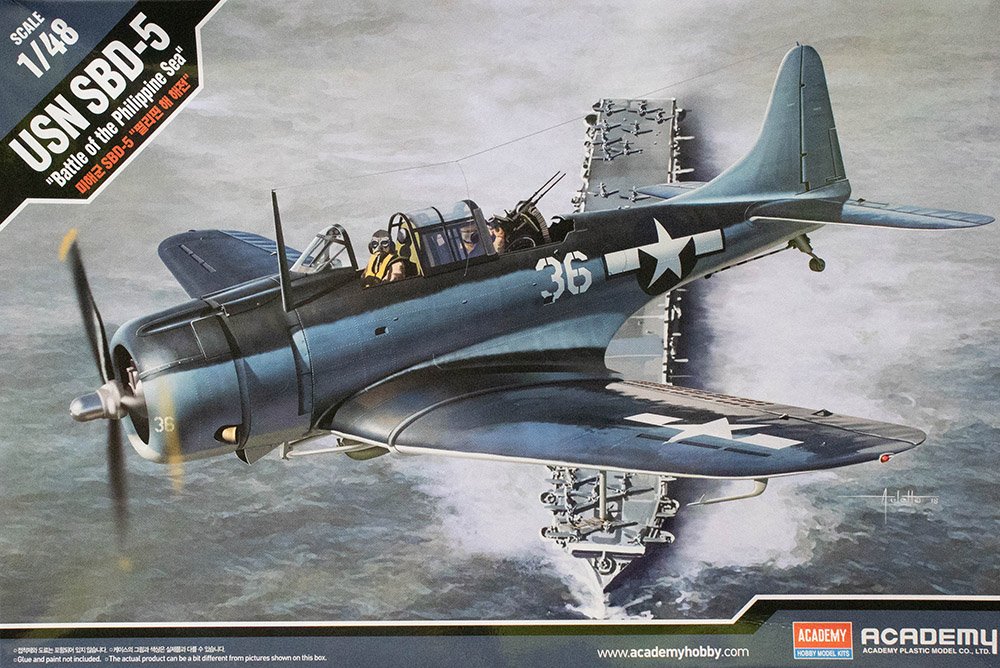
Douglas Dauntless. (Source: Image courtesy of Academy Hobby Model Kits)
My Comparison: Academy SBD-5 Dauntless, Kit 12329
For comparison, I purchased the Academy SBD-5 Dauntless, catalog number 12329, in 1:48 scale.
I find this comparison particularly interesting because both kits represent the same famous aircraft family, but they approach the subject from different perspectives.
The Academy model represents the SBD-5, a later development of the Dauntless, while Border Model’s BG-003 represents the earlier SBD-3 and SBD-4 versions.
The Academy kit is based on the well-regarded Accurate Miniatures tooling and offers a detailed conventional plastic modeling experience. Its features include detailed front and rear cockpits, a radial engine representation, positionable dive flaps, photo-etched components, and masks for the transparent canopy parts.
The Academy kit also provides three marking options, representing aircraft associated with the USS Enterprise, USS Yorktown, and the United States Marine Corps.
Here is a direct comparison of their main characteristics:
| Feature | Border Model | Academy |
|---|---|---|
| Aircraft | SBD-3/4 Dauntless | SBD-5 Dauntless |
| Scale | 1:35 | 1:48 |
| Kit number | BG-003 | 12329 |
| Manufacturer | Border Model | Academy |
| Main concept | Chroma Series, pre-painted components | Conventional plastic kit |
| Interior | Extensive, full interior | Detailed front and rear cockpits |
| Photo-etched parts | Included | Included |
| Clear parts | Included | Included |
| Marking options | 3 | 3 |
| External stores | Bombs and drop tanks | Bomb and other kit accessories |
The most obvious difference is scale. A 1:35 Dauntless offers a considerably larger display presence than its 1:48 counterpart. It also provides more room for highlighting cockpit details, structural components, and weathering effects.
The Academy kit, on the other hand, offers a more traditional aircraft modeling experience. Its detailed cockpit, well-represented dive brakes, canopy masks, and established tooling make it an attractive choice for anyone interested in the SBD-5.
I see these two models as complementary rather than competing products. They represent different versions of the aircraft and offer different opportunities for a scale modeling collection.
Conclusion: Two Interpretations of an Aviation Classic
Border Model’s 1:35 Douglas SBD-3/4 Dauntless is an interesting addition to the world of military aircraft modeling.
Its unusual scale, extensive interior, photo-etched details, external stores, and Chroma Series pre-painted components give it a distinctive identity. It is particularly appealing to modelers who enjoy working with larger aircraft subjects and appreciate the opportunity to display interior details through the extensive canopy.
Personally, I welcome the pre-painted approach for the cockpit and canopy areas, where it can simplify difficult painting tasks and provide a useful foundation. However, I prefer to retain complete control over the fuselage finish, since exterior painting and weathering are essential parts of my own modeling philosophy.
My Academy 1:48 SBD-5 Dauntless provides an interesting point of comparison. While it represents a later aircraft variant and follows a more conventional construction approach, it demonstrates how versatile and enduring the Dauntless remains as a modeling subject.
Ultimately, both kits celebrate an aircraft whose historical importance extends far beyond its technical specifications. The Douglas SBD Dauntless represents determination, engineering, and the development of American naval aviation during one of the most demanding periods in military history.
Whether built in 1:35 or 1:48 scale, the Dauntless remains a rewarding subject for anyone interested in historical accuracy, aircraft engineering, and the art of scale modeling.
