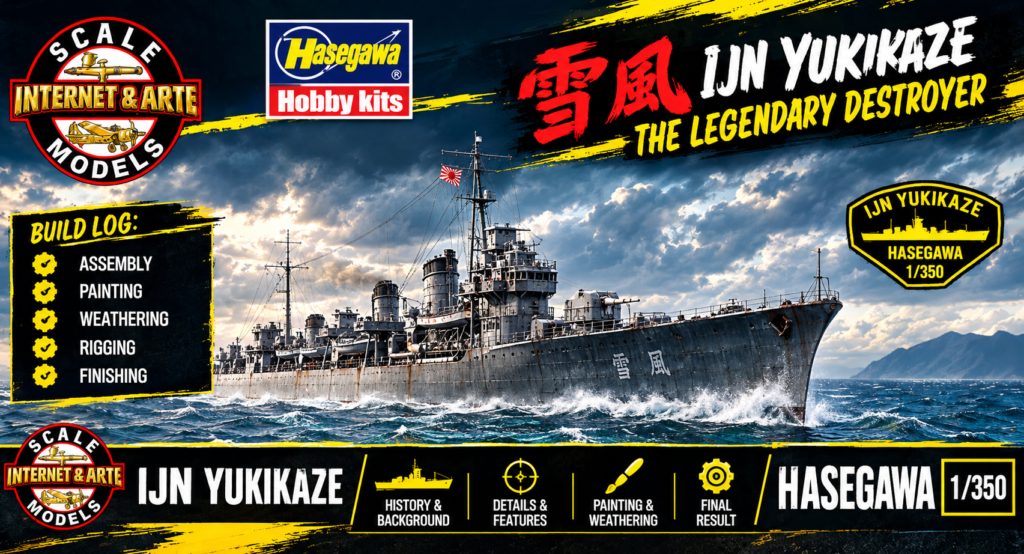
IJN Yukikaze

IJN Yukikaze: The Lucky Destroyer of the Imperial Japanese Navy
From the Battles of the Pacific to the Final Mission of Operation Ten-Go – 1945
A Destroyer That Defied the Odds
Among the many warships that served in the Imperial Japanese Navy during World War II, few have acquired a reputation as remarkable as the destroyer IJN Yukikaze. Known as the Lucky Destroyer, she became famous not because she was the largest, most heavily armed, or most powerful warship in the Japanese fleet, but because she repeatedly survived some of the most destructive naval engagements of the Pacific War.
Her story is one of combat, endurance, sacrifice, and extraordinary survival. From the opening campaigns of the Pacific conflict to the final desperate sortie of the Japanese fleet in April 1945, Yukikaze witnessed the destruction of numerous ships that sailed alongside her. Yet she continued to return to port, earning a legendary reputation among Japanese sailors.
I recently purchased the Hasegawa 1/350 scale model kit depicting IJN Yukikaze in her 1945 configuration during Operation Ten-Go. This particular moment in the ship’s history makes the subject especially interesting to me. It represents the final chapter of the Imperial Japanese Navy’s surface fleet and offers an opportunity to explore one of the most extraordinary destroyer stories of World War II through scale modeling.
Construction and Early Service
Yukikaze belonged to the Kagero-class, a group of modern fleet destroyers developed by Japan during the late 1930s. These vessels were designed to operate alongside the Imperial Japanese Navy’s major combat formations, providing screening, torpedo attack capabilities, and protection against enemy surface ships and submarines.
Her keel was laid down at the Sasebo Naval Arsenal on August 2, 1938. She was launched on March 24, 1939, and officially commissioned on January 20, 1940.
With a standard displacement of approximately 2,000 tons, a length of 118.5 meters, and a beam of 10.8 meters, Yukikaze combined a relatively compact hull with impressive speed and offensive power.
Her machinery consisted of geared steam turbines producing approximately 52,000 shaft horsepower, allowing her to achieve speeds of around 35 knots.
At the beginning of her career, her principal armament consisted of three twin 127 mm gun turrets and two quadruple 610 mm torpedo launchers. The latter could fire the famous Type 93 torpedo, commonly known as the Long Lance, one of the most advanced oxygen-powered torpedoes of its time.
As the Pacific War progressed, however, the increasing threat posed by Allied carrier aviation forced the Japanese Navy to strengthen the antiaircraft capabilities of its surviving warships. Yukikaze underwent modifications that increased her light antiaircraft armament and introduced radar equipment, reflecting the changing realities of naval warfare.
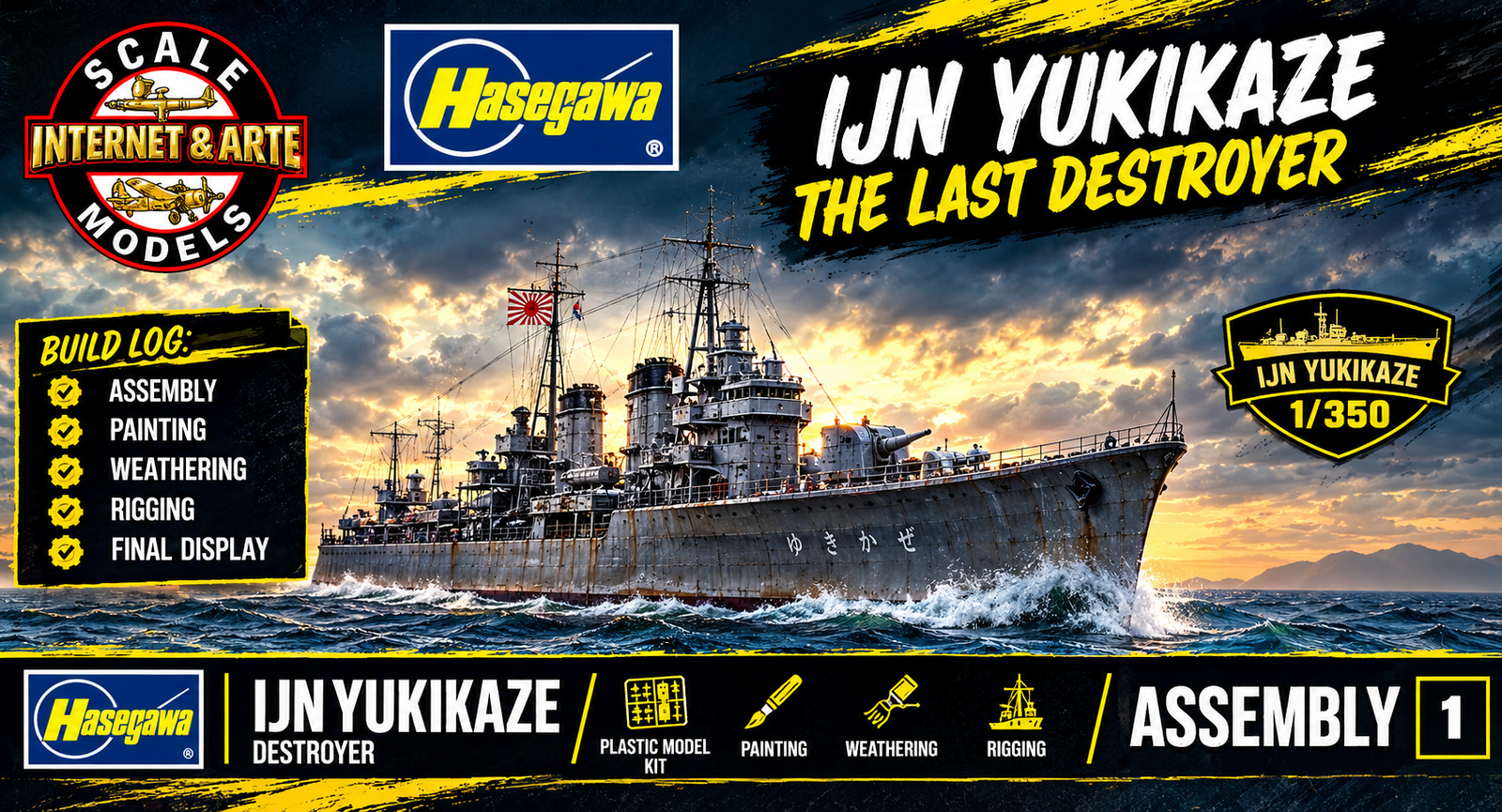
Through the Major Campaigns of the Pacific War
Yukikaze entered World War II during a period of rapid Japanese expansion across the Pacific and Southeast Asia.
Her early wartime assignments included escorting invasion convoys and supporting Japanese operations in the Philippines and the Dutch East Indies. She also participated in operations associated with the Battle of the Java Sea in February 1942, where Japanese naval forces defeated Allied forces attempting to prevent the invasion of the Netherlands East Indies.
As the war expanded, Yukikaze became involved in increasingly dangerous operations.
She participated in the Midway campaign in June 1942, one of the decisive turning points of the Pacific War. Although the Japanese suffered a catastrophic carrier defeat, Yukikaze survived and continued serving with the fleet.
Later, she operated in the Solomon Islands campaign, including the intense naval fighting around Guadalcanal. These waters became some of the most dangerous operational areas for Japanese destroyers, where night engagements, torpedo attacks, air raids, and submarine threats created enormous losses.
Yukikaze also took part in operations associated with the Battle of the Santa Cruz Islands in October 1942, supporting Japanese carrier forces.
Her wartime experience continued through the central Pacific campaigns, including the Mariana Islands and the Battle of Leyte Gulf in October 1944.
By this stage, the Imperial Japanese Navy had lost much of its former strength. Its carrier force had been severely weakened, experienced aircrews were increasingly difficult to replace, and Allied naval and air superiority was becoming overwhelming.
Yukikaze nevertheless continued operating, frequently performing escort and screening duties while surviving the destruction of other ships around her.
This repeated survival gradually established her reputation as one of the luckiest destroyers in Japanese naval history.
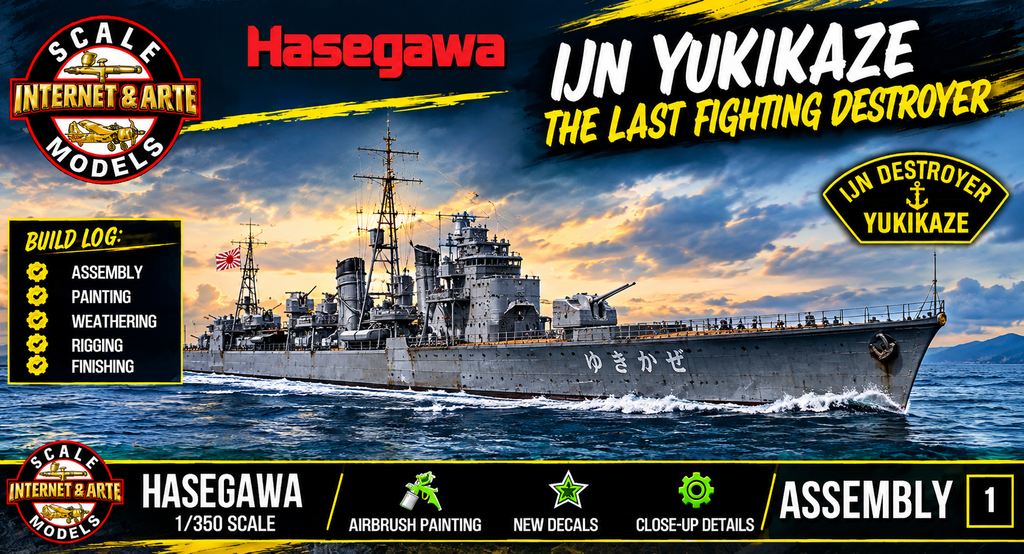
The Final Chapter: Operation Ten-Go, April 1945
The historical significance of Yukikaze reached its climax during Operation Ten-Go in April 1945.
By this time, Allied forces had landed on Okinawa, bringing the war dangerously close to the Japanese home islands. The Japanese military leadership recognized that the situation was becoming increasingly desperate.
The Imperial Japanese Navy organized a final major surface operation intended to support the defense of Okinawa. The force was centered around the battleship Yamato, accompanied by the light cruiser Yahagi and eight destroyers.
The mission was extraordinarily dangerous.
The Japanese force was ordered to proceed toward Okinawa, where Yamato was expected to fight against the Allied fleet and, if necessary, be grounded to serve as a stationary artillery platform. The ships were supplied with fuel sufficient for the outward journey, making the operation effectively a one-way mission.
Yukikaze was among the destroyers assigned to this force.
On April 6, 1945, the Japanese ships departed from Tokuyama and headed south toward Okinawa. American intelligence had already detected their movements, and powerful carrier task forces were prepared to intercept them.
On April 7, the attack began.
American carrier aircraft launched successive waves of bombers and torpedo aircraft against the Japanese formation in the East China Sea. The overwhelming air assault quickly transformed the operation into a disaster for the Imperial Japanese Navy.
Yamato, the largest battleship ever constructed, was struck repeatedly by bombs and torpedoes. Her antiaircraft guns fought desperately, but the concentrated American attacks proved impossible to stop.
The battleship eventually capsized and exploded, disappearing beneath the sea.
The cruiser Yahagi was also sunk, along with several destroyers, including Hamakaze, Isokaze, Kasumi, and Asashimo.
Yukikaze, however, survived.
Although she suffered damage and lost three crewmen during the attack, she remained operational. Together with the surviving Japanese destroyers, she helped rescue sailors from the burning and sinking ships.
This rescue operation became one of the most remarkable aspects of her participation in Ten-Go. The destroyers that had survived the air attacks took aboard hundreds of Japanese sailors who otherwise would have been lost in the sea.
The Japanese fleet had suffered an almost complete defeat, but Yukikaze once again returned from an engagement in which numerous companion ships had been destroyed.
Her survival during Operation Ten-Go cemented her reputation as the Lucky Destroyer.
The 1945 Appearance: A Ship Prepared for Survival
The Yukikaze depicted during Operation Ten-Go represents a very different vessel from the destroyer that entered service in 1940.
Years of combat experience had transformed her appearance. The original emphasis on surface warfare had increasingly given way to antiaircraft defense, radar-assisted operations, and the protection of increasingly vulnerable naval formations.
Her 1945 configuration reflected the Japanese Navy’s urgent attempts to improve the defensive capabilities of its remaining destroyers.
The addition of numerous Type 96 25 mm antiaircraft weapons gave her a much more heavily armed appearance. Radar equipment also became an important feature of her wartime silhouette.
For scale modelers, this late-war configuration is particularly attractive because it captures the technological and operational changes that occurred during the final years of the Pacific War.
The combination of the original Kagero-class hull design, additional antiaircraft weapons, radar equipment, and the numerous details associated with a veteran warship makes Yukikaze an especially interesting subject in 1/350 scale.
After the War: A Second Life
Unlike many Japanese warships that disappeared during the final months of World War II, Yukikaze survived the conflict.
Following Japan’s surrender in August 1945, she was used for repatriation duties, transporting Japanese military personnel and civilians back to their homeland.
These missions were an important part of the difficult postwar recovery. The destroyer reportedly completed fifteen repatriation voyages, bringing more than 13,000 people back to Japan.
In July 1947, Yukikaze was transferred to the Republic of China as part of Japan’s postwar naval reparations.
She was renamed ROCS Dan Yang and entered service with the Republic of China Navy.
Remarkably, her operational career continued for many years after the end of World War II. Dan Yang served through the 1950s and into the 1960s before being decommissioned in November 1966.
The vessel was eventually scrapped, but elements of her original identity survived through preserved historical artifacts, including her steering wheel, which was returned to Japan.
Her postwar career adds another remarkable dimension to the history of a destroyer that had already experienced some of the most dramatic events of the Pacific conflict.
My Hasegawa 1/350 Scale Modeling Project
My decision to purchase the Hasegawa 1/350 scale IJN Yukikaze kit was motivated by the ship’s extraordinary history and, particularly, her participation in Operation Ten-Go.
I find this period of Japanese naval history especially fascinating because it represents the final operational chapter of a once-powerful fleet. The Yukikaze is an excellent subject through which to explore this transformation.
The 1/350 scale offers an excellent opportunity to appreciate the proportions of the Kagero-class destroyer while reproducing the extensive details of her 1945 configuration.
The antiaircraft weapons, radar installations, gun turrets, torpedo launchers, deck fittings, and complex superstructure all contribute to the visual character of the vessel.
For me, the historical context is just as important as the construction itself. I want the finished model to represent more than simply a Japanese destroyer. It should evoke the atmosphere of April 1945, when Yukikaze sailed alongside Yamato and Yahagi during the final major sortie of the Imperial Japanese Navy.
The contrast between the enormous battleship and the comparatively small destroyer is particularly meaningful. Yamato represented the immense industrial and military ambition of Imperial Japan, while Yukikaze represented the endurance of a smaller warship that repeatedly survived battles that destroyed much larger vessels.
Conclusion: The Legend of the Lucky Destroyer
The history of IJN Yukikaze is a remarkable story of survival during one of the most destructive naval conflicts in modern history.
She participated in numerous major operations, witnessed the loss of powerful warships, survived the disastrous Operation Ten-Go, and continued serving after the war under a different flag.
Her reputation as the Lucky Destroyer was not simply the result of legend. It emerged from an extraordinary operational record and the repeated survival of a vessel that sailed through some of the most dangerous waters of the Pacific War.
With my Hasegawa 1/350 scale kit, I look forward to bringing this historic destroyer to life in miniature, representing her final wartime configuration during Operation Ten-Go in 1945.
For a scale modeler interested in World War II naval history, Yukikaze offers something truly special: a warship whose story extends beyond the battles she fought and whose survival became part of her historical identity.
IJN Yukikaze — the destroyer that survived the final voyage of the Imperial Japanese Navy.
https://www.youtube.com/shorts/3riv-gL94n4
✈️⚓ Help me keep building — book included.
The Internet & Arte is where I share every aircraft and ship I build, step by step — powered by readers like you.
Become a patron today and read my book Zero Fighter Historical Society instantly — the full ebook, directly on Patreon.
Your monthly support does three things:
- 📖 Puts the book on your screen — no shipping, no waiting
- 🔍 Funds new kits, tools and step-by-step build articles
- 🛩️ Keeps me at the bench — whether the next build flies or floats
Become a Patron & Start Reading →
To the patrons already aboard: thank you. You’re the reason the builds keep coming.
📬 Prefer it on your shelf? For printed copies of the book, get in touch — just send me a message on Patreon.
